Today's
EarthStation1.com 15% Off Commemorative Memorial Title: Jack Benny
Complete Radio Broadcasts Set MP3 DVD, Audio Download, USB
Today, April 11, 2026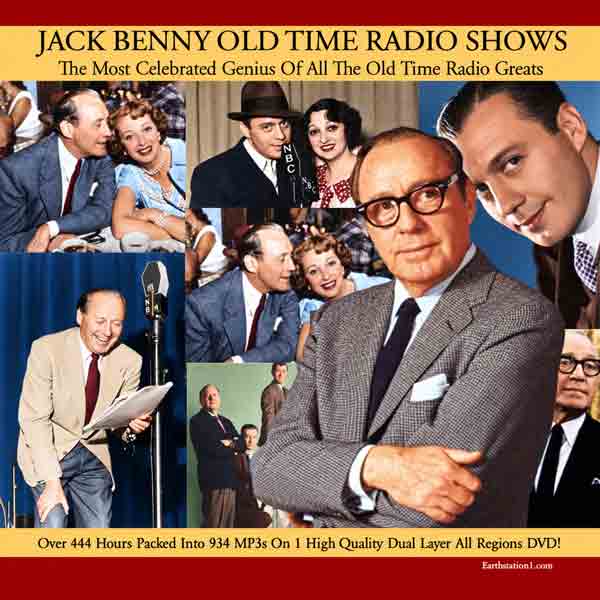
April 11: National Clean Up Your Pantry
Day: -- Usually, we buy far more things than we require. It
happens pretty occasionally, because as we keep shopping for more,
more pantry items remain unused and are eventually stuffed into
closets and drawers. This leads to the storage of far more food
stuff than we are able to consume before the products expire. At a
point, we can no longer keep a track of those items, which simply
means wastage. This National Clean Up Your Pantry Day, explore
your pantry, look up unused and expired items, and donate spare
stuff to the needy. A pantry is a dedicated space, a room, or a
cabinet, where items related to the kitchen are stored. These
items can be beverages, food, utensils, cleaning supplies, linens,
and groceries. The term 'pantry' was first used during the Middle
Ages to refer to domestic spaces. Colonists in New England used to
store food in a "buttery," which was a small room near a
kitchen. The first buttery was an underground room in the Theron
Boyd homestead in Hartford, U.S. in 1786. The "butler's
pantry" was popular in England and America during the 1800s.
"Practical Housekeeper" magazine, published a quote by
Mrs. Elizabeth Ellet in 1857: "Let there be a place for every
object, and when not in use, let every article be in its place."
In 1869, Catharine Beecher and Harriet Beecher Stowe published a
fundamental work that endorsed the idea of incorporating the
pantry into the kitchen, called "The American Woman's Home."
The Boston Cooking-School Magazine was established in 1896 under
the influential home-economics movement that inspired American
housewifery and kitchen design. During the 1920s and 1930s, as the
pantry expanded in size with more shelves and cupboards, the
increasingly fashionable 'breakfast nook' began to displace
pantries in the kitchen layout. By the 1960s, floor-to-ceiling
cabinets became a part of American kitchen design. Three decades
later, during the 1990s, a preference for separate storage spaces
led to a noticeable resurrection in the use of pantries across
America. According to a 2005 poll by the National Association of
Home Builders, walk-in pantries were the most liked kitchen
feature in American homes that year. On Sale @ 15% Off Discount
Till Midnight PT!
https://store.earthstation1.com/jack-benny-complete-radio-broadcasts-dual-layer-mp3-dv3.html
Today's
EarthStation1.com 15% Off Commemorative Memorial Title: Super
Sense Animal Perception/Plant Adaptation TV Series DVD, MP4, USB
Today, April 11, 2026
April 11: National Pet Day: -- A day
dedicated to those pets who may not always get the companionship
and attention pets deserve. While loving our pets is something we
do every day, the observance encourages helping out orphaned pet
companions. It will improve their health and enhance their
opportunities for adoption. Sometimes their human companions
aren't well. Making sure their forever furry friends are receiving
the best of care will help relieve stress and worry. National Pet
Day is an excellent time to do a few checks for your pets: Go
through your furever family member's toys. Throw away any items
that are no longer safe; Maintain your pet-friendly home. Keep
cords and toxins secure from your four-legged friends. This
includes phone chargers; Verify when vaccinations are due and
schedule an appointment to update if they are due; and Check
collars to ensure tags are secure and numbers are current. We
sometimes forget to update this information when we move or change
numbers. To observe National Pet Day, take supplies to those pets
in shelters. Help a friend with pets who is recovering from an
illness. Adopt a pet. Give your pets extra love with a bath and
rub down. Use #NationalPetDay on social media. Celebrity Pet
Lifestyle Expert & Animal Welfare Advocate Colleen Paige
founded the day in 2005. On Sale @ 15% Off Discount Till Midnight
PT!
https://store.earthstation1.com/super-sense--animal-perception-tv-series-dvd-mp4-download-usb-driv4.html
Today's
EarthStation1.com 15% Off Commemorative Memorial Title: Challenge
Of The Yukon Old Time Radio Series MP3 Set DVD Download USB
Today, April 11, 2026
April 11: Dog Therapy Appreciation Day:
-- Today we show our appreciation to the dogs who comfort us by
being therapy dogs. Therapy dogs go through a rigorous testing
program before they become certified. With their certification,
they become eligible to visit hospitals and nursing homes to give
comfort to people. Therapy dogs are usually at first pets who
receive training and then become therapy dogs. Being around dogs
makes everyone happy, and on this day we thank dogs for making us
happier. Animal-assisted therapy has been used way back since the
ancient Greeks. Horses were used throughout history to treat
people. In the 1600s, physicians used horses to improve the
physical and mental health of patients. Florence Nightingale in
the 1800s observed that pets can reduce levels of anxiety and
stress in adults. A wave of informal experiments which involved
animals' interaction with humans began to produce a calming effect
on patients suffering from anxiety. Sigmund Freud became intrigued
with the connection between humans and animals and developed the
idea of the Human-Animal Bond. His theory described that humans
need interaction with animals and nature to normalize daily life.
Freud is known to use his pet to calm his patients. In the 1940s,
the American Red Cross used farm animals to treat war veterans
suffering from injury or illness. Veterans would take care of the
farm animals to ease their minds and not think about the gruesome
war. In the 1960s, Dr. Boris Levinson discovered that his dog
positively affected mentally impaired young patients. He also
noticed that patients were more comfortable and social with their
dogs than with other humans. According to some studies, having a
pet can help you live a longer and happier life. Dogs can reduce
the risk of heart disease, and for those who had suffered heart
disease, owning a dog or a cat decreased the risk of another heart
attack. On Sale @ 15% Off Discount Till Midnight PT!
https://store.earthstation1.com/challenge-of-the-yukon-mp3-dvd-complete-radio-broadcast3.html
Today's
EarthStation1.com 15% Off Commemorative Memorial Title: Fibber
McGee And Molly Complete Radio Series MP3 DVD, Download, USB
Today, April 11, 2026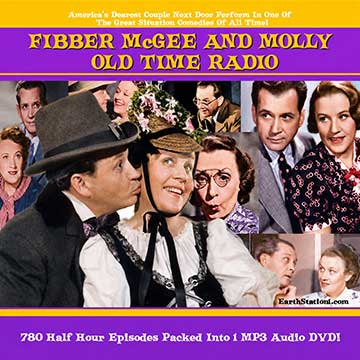
April 11: Barbershop Quartet Day: -- Like
its name, this type of music was first documented in the late
1800s while men waited to get their hair cut. They passed the time
by singing and harmonizing songs with the barbers and fellow
customers in the shop. From this introduction in classic
barbershops until now, barbershop music has become increasingly
popular and portrayed in film and television. Even today, talented
men and women quartets compete nationally and around the world.
Barbershop music is deeply rooted in African American history.
Throughout the 1880s in the South, men mingled with barbers and
others in the shop while waiting for their haircut. They sang and
harmonized together for entertainment. This sound turned into a
genre called barbershop music and continued thriving from then
until the early 1900s. In 1910, a song titled 'Play That
Barbershop Chord' was recorded and released to the public as a
prime example of barbershop harmony. This art of harmonized
singing was to produce a style of a cappella without the need for
accompanying music. Each quartet sang songs with
easy-to-understand lyrics and catchy melodies. After 1929,
barbershop music started to become less popular and even less
common during The Great Depression. In 1938, two men: Rupert Hall
and O.C. Cash sent out invitations for a songfest to 14 people who
were encouraged to invite others. On April 11, approximately 25
men met in Tulsa, Oklahoma, and held a quartet singing
competition. They continued to meet and grow in numbers,
consequently creating a revival in barbershop music and founding
the Society of Preservation and Encouragement of Barber Shop
Quartet Singing in America, Inc. (SPEBSQSA). Thankfully, since
2004, they are more commonly known as the Barbershop Harmony
Society. Not long after the founding of SPEBSQSA, a woman formed
an all-women organization in Tulsa named Sweet Adelines
International in 1945. A little less than a decade later, in 1957,
several women split from the Sweet Adelines in an effort to be
more accepting of admissions from African Americans. From this act
of protest, Harmony, Incorporated, was founded in 1959 in Rhode
Island by a group of five women. Now diverse men and women are
allowed and accepted in the same quartet and compete all over the
world. On Sale @ 15% Off Discount Till Midnight PT!
https://store.earthstation1.com/fibber-mcgee-and-molly-mp3-dvd-complete-radio-serie3.html
Today's
EarthStation1.com 15% Off Commemorative Memorial Title: WABC Radio
Airchecks MP3 Collection 1960s-1980s DVD, MP3 Download, USB
Today, April 11, 2026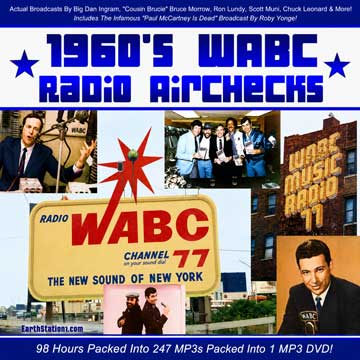
April 11: International Louie Louie Day:
-- April 11, 1935: #BOTD: #HBD! Richard Berry, African American
singer, songwriter and musician who performed with many Los
Angeles doo-wop and close harmony groups in the 1950s, including
the Flairs and the Robins, best known as the composer and original
performer of the rock standard "Louie Louie", the most
recorded rock song of all time (d. January 23, 1997) is #born
Richard Berry Jr. in Extension, south of Monroe, Louisiana, and
moved with his family to Los Angeles as a baby. As a child, he
suffered a hip injury and had to walk on crutches until he was
six. He began singing and playing in local doo-wop groups,
recording with a number of them including the Penguins, the
Cadets, the Chimes, the Crowns, the Five Hearts, the Hunters, the
Rams, the Whips, and the Dreamers, an otherwise all-female quartet
from Fremont High. He then joined the Flairs (who also recorded as
the Debonaires and the Flamingoes) in 1953. The Flairs' 1953
record "She Wants to Rock" on Modern Records featured
Berry's bass vocals, and was an early production by Leiber and
Stoller. A few months later, when the producers needed a bass
voice for the Robins' "Riot In Cell Block #9" on Spark
Records, they recruited Berry to provide the menacing lead vocal
on the song - uncredited because he was contracted to Modern.
Berry's voice was used at Modern, again uncredited, as the
counterpoint to Etta James on her first record and big hit "The
Wallflower (Dance with Me, Henry)" and several of its less
successful follow-ups. Berry also recorded with several other
groups on the Modern and Flair labels, including Arthur Lee Maye
and the Crowns, and the Dreamers (who later became the Blossoms).
By the end of 1954, Berry left the Flairs to form his own group,
the Pharaohs, as well as continued to work with other groups as a
singer and songwriter. In 1955, Berry was inspired to write "Louie
Louie", a calypso-style song, based on the Rhythm Rockers'
version of Rene Touzet's "El Loco Cha Cha", as well as
influenced by Chuck Berry's "Havana Moon". Berry also
stated he had Frank Sinatra's "One for My Baby" in mind
when writing the lyrics. One night while waiting backstage at
Anaheim's Harmony Park Ballroom, Berry took the rhythm of "El
Loco Cha Cha" and began to add lyrics, writing them on toilet
paper. Richard Berry and the Pharaohs recorded and released the
song as the B-side to his cover of "You Are My Sunshine"
on Flip Records in 1957. It became a minor regional hit, selling
130,000 copies. It was re-released as an A-side, and when the
group toured the Pacific Northwest, several local R & B bands
began to adopt the song and established its popularity. "Louie
Louie" finally became a major hit when the Kingsmen's raucous
version - with little trace of its calypso-like origins other than
in its lyrics - became a national and international hit in 1963.
Paul Revere & the Raiders also recorded the tune in the same
studio the week after the Kingsmen, but their version was not a
hit. The nearly unintelligible (and innocuous) lyrics were widely
misinterpreted as obscene, and the song was banned by radio
stations and even investigated by the Federal Bureau of
Investigation. The song has been recorded over 1,000 times.
However, Berry received little financial reward for its success
for many years, having sold the copyright for 750 USD in 1959 to
pay for his wedding. Berry said in 1993 "Everybody sold their
songs in those days. I never was bitter with the record companies.
They provided a vehicle for five young black dudes to make a
record." Berry continued to write and record into the early
1960s, including "Have Love, Will Travel" (which later
became a local hit for the Sonics), but with little commercial
success, and also continued as a performer. Other songs included
"Crazy Lover", recorded by the Rollins Band and "Oh!
Oh! Get Out of the Car", covered by the Treniers. For Rhino's
1983 The Best of Louie, Louie compilation album, Berry created a
note-for-note re-recording of "Louie Louie" because
licensing could not be obtained for the original version. Backup
vocals were provided by doo wop revival group Big Daddy. The
original version was not legitimately re-released until the Ace
Records Love That Louie compilation in 2002. In the mid-1980s,
Berry was living on welfare at his mother's house in South Central
Los Angeles. Drinks company California Cooler wanted to use "Louie
Louie" in a commercial, but discovered it needed Berry's
signature to use the song. The company asked the Artists Rights
Society to locate him, and a lawyer visited Berry. The lawyer
mentioned the possibility of Berry's taking action to gain the
rights to his song. The publishers settled out of court, making
Berry a millionaire. In the early 1980s, Berry recorded a duet
with his ex-wife Dorothy titled 'The World Needs Peace'. He
re-recorded it a few years later in a gospel version retitled
"What We Need", with his six children providing backup
harmony vocals. During the 1980s, "Louie Louie" received
a number of accolades, with hundreds of cover versions issued on
CD compilations and played on radio marathons. He continued to
play shows and in 1993 played two sets at the 100 Club in London.
Berry married Dorothy Adams, a girl with whom he attended high
school, in 1957, and they had two children, Pam and Marcel. They
divorced in 1968. Dorothy pursued a music career, recording for
Garpax Records, Challenge Records, Little Star Records and
Tangerine. She was a Raelette for Ray Charles until the early
1980s. Berry had six children in total, Pamela, Richard Marcel,
Stephani, Karen, Linda and Christy. Christy, who was born in 1969,
handled his career in his later years. Marcel played bass on stage
with his father in the 1980s. In February 1996, Berry performed
for the final time, reuniting with the Pharaohs and the Dreamers
for a benefit concert in Long Beach, California. His health
declined shortly afterward, and he died of heart failure on
January 23, 1997. He is interred in the Inglewood Park Cemetery in
Inglewood, California. On Sale @ 15% Off Discount Till Midnight
PT!
https://store.earthstation1.com/wabc-musicradio-shows-mp3-dvd-60s80s-am-360807775.html
Today's
EarthStation1.com 15% Off Commemorative Memorial Title: TV Music &
Dance Shows #13 Byrds Kingsmen Hondells DVD MP4 Flash Drive
Today, April 11, 2026
April 11: International Louie Louie Day:
-- April 11, 1935: #BOTD: #HBD! Richard Berry, African American
singer, songwriter and musician who performed with many Los
Angeles doo-wop and close harmony groups in the 1950s, including
the Flairs and the Robins, best known as the composer and original
performer of the rock standard "Louie Louie", the most
recorded rock song of all time (d. January 23, 1997) is #born
Richard Berry Jr. in Extension, south of Monroe, Louisiana. In
1955, Berry was inspired to write "Louie Louie", a
calypso-style song, based on the Rhythm Rockers' version of Rene
Touzet's "El Loco Cha Cha", as well as influenced by
Chuck Berry's "Havana Moon". Berry also stated he had
Frank Sinatra's "One for My Baby" in mind when writing
the lyrics. One night while waiting backstage at Anaheim's Harmony
Park Ballroom, Berry took the rhythm of "El Loco Cha Cha"
and began to add lyrics, writing them on toilet paper. Richard
Berry and the Pharaohs recorded and released the song as the
B-side to his cover of "You Are My Sunshine" on Flip
Records in 1957. It became a minor regional hit, selling 130,000
copies. It was re-released as an A-side, and when the group toured
the Pacific Northwest, several local R & B bands began to
adopt the song and established its popularity. "Louie Louie"
finally became a major hit when the Kingsmen's raucous version -
with little trace of its calypso-like origins other than in its
lyrics - became a national and international hit in 1963. Paul
Revere & the Raiders also recorded the tune in the same studio
the week after the Kingsmen, but their version was not a hit. The
nearly unintelligible (and innocuous) lyrics were widely
misinterpreted as obscene, and the song was banned by radio
stations and even investigated by the Federal Bureau of
Investigation. The song has been recorded over 1,000 times.
However, Berry received little financial reward for its success
for many years, having sold the copyright for 750 USD in 1959 to
pay for his wedding. Berry said in 1993 "Everybody sold their
songs in those days. I never was bitter with the record companies.
They provided a vehicle for five young black dudes to make a
record." In honor of Richard Berry, International Louie Louie
Day is celebrated on his birthday, a date was chosen as the most
significant date for International Louie Louie Day from a list of
"Louie Louie"-related dates occurring in April,
including: April 6, 1963 - The Kingsmen recorded the version that
made "Louie Louie" famous; April 13, 1963 - Paul Revere
and the Raiders recorded their competing version in the same
studio; April 1, 1985 - First annual WMMR Louie Louie Parade in
Philadelphia (canceled in 1989 due to excessive rowdiness); April
12, 1985 - "Louie Louie Day" proclaimed by the state of
Washington; April 14, 1985 - "Louie Louie Day"
proclaimed by the mayor of Seattle; April 2, 1986 - "Louie
Louie Day" proclaimed by the state of Oregon; April 10, 1998
- The Kingsmen won a historic legal case against Gusto
Records/GML, regaining ownership and royalty rights to all their
recordings. Support for International Louie Louie Day and other
"Louie Louie"-related observances is provided by the
Louie Louie Advocacy and Music Appreciation Society (LLAMAS) and
"Louie Louie" fans worldwide. Commemorations of
International Louie Louie Day have included newspaper articles,
magazine stories, and radio programs with discussions of the
song's history and playlists of multiple "Louie Louie"
versions. In 2011, KFJC celebrated International Louie Louie Day
with a reprise of its 1983 "Maximum Louie Louie" event,
featuring multiple "Louie Louie" versions, new music by
Richard Berry and appearances by musicians, DJs, and celebrities
with "Louie Louie" connections. On Sale @ 15% Off
Discount Till Midnight PT!
https://store.earthstation1.com/classic-tv-music-amp-dance-shows-13-byrds-kingsmen-hondells-d13.html
Today's
EarthStation1.com 15% Off Commemorative Memorial Title: TV
Commercials: The Cable Age Classics II DVD, Download, USB Drive
Today, April 11, 2026
April 11: National Eight Track Tape Day
(National 8-Track Day): -- A great day to bust out your old
8-track tape collection and explain to the confused millennials
and Gen Zs what it is. You know it was the hottest technology from
the mid-1960s to the early 1980s, and you love remembering all the
sweet jams you listened to with your eight track from that era.
Did you know the eight track tape was designed by a jet plane
designer? While William Powell Lear is best known for his jet, the
Learjet, he also developed a way to create eight channels (tracks)
of magnetic recording tape. This invention revolutionized music
technology and the way we hear our tunes - for just a little
while. The eight track tape fad really only existed in the United
States from the mid-1960s to the late 1980s, when cassette tapes
took over. With Lear's new device, the eight track tape, it was
possible to record one continuous loop of tape and wind it into a
cartridge without damaging sound quality. The automobile industry
was quick to capitalize on the new trend and install eight track
players in their new lines of vehicles. In 1966, Ford offered both
factory-installed and dealer-installed eight track players in its
luxury vehicles, and Chrysler and General Motors followed suit by
1967. In 1966, over 65,000 players were sold, and their eight
track was becoming an important part of driving in America. In
fact, the convenience and portability enjoyed in the car began to
spread into the home and more. The eight track soon transcended
driving culture as it was brought to parks and beaches across the
nation. In 1970, eight track manufacturing was brought to Europe.
Though the attempt was largely unsuccessful and the company failed
in just four short years, vintage eight tracks can still be found
in the United Kingdom, West Germany, Italy, and more. The first
karaoke machine was actually made from an eight track! The fame of
the eight track was on the rise for a decade. Competitors who
created smaller cassette tapes found methods of increasing
quality, and the ease of damaging and decreasing quality of the
eight track drove consumers to embrace a new decade of music
technology. The smaller cassette, which was only a third the size
of an eight track tape, was already favored by the mid-1970s.
Retail stores stopped selling eight track tapes in the 1980s, and
by 1988, the last famous album released on eight track had come
and gone. The once-stunning piece of technology became a footnote
in the history books, but many fans of that era of music and
culture can still dig up an old eight track tape in the attic and
recall fond memories of hitting the open roads listening to their
favorite tunes. On Sale @ 15% Off Discount Till Midnight PT!
https://store.earthstation1.com/tv-commercials-the-cable-age-classics-ii-dvd.html
Today's
EarthStation1.com 15% Off Commemorative Memorial Title: Submarine
D-1 1937 Pat O'Brien George Brent Wayne Morris DVD MP4 USB
Today, April 11, 2026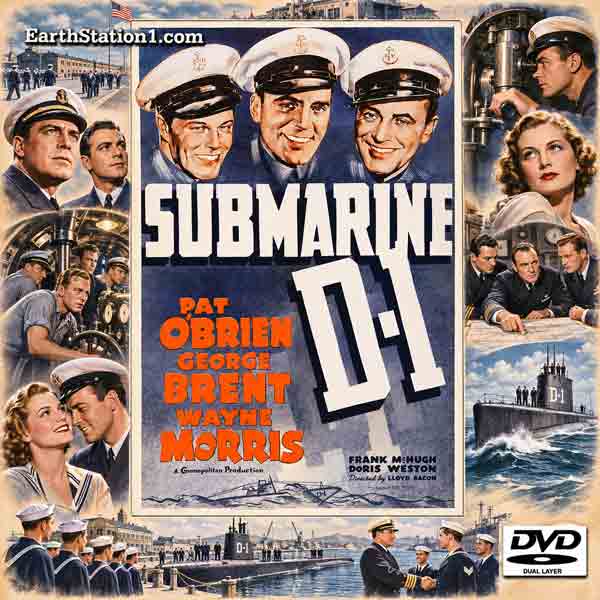
April 11: National Submarine Day: -- The
Holland VI is purchased by the United States Navy on April 11,
1900, becoming the Navy's first commissioned submarine, christened
USS Holland. The Holland Type VI submarine, which used internal
combustion engine power on the surface and electric battery power
underwater, was launched on May 17, 1897 at Navy Lt. Lewis Nixon's
Crescent Shipyard into the narrows of the Kill Van Kull at the
mouth of Newark Bay at Elizabeth, New Jersey, at the current
location of Elizabeth's Memorial Waterfront Park. USS Holland
(SS-1) was not the first military submarine of the United States,
which was the famed 1775 submersible Turtle. USS Holland was
originally laid down as Holland VI at the Crescent Shipyard of
Elizabeth, New Jersey for John Holland's Holland Torpedo Boat
Company, and launched on May 17, 1897. She was acquired by the USN
on April 11, 1900, and commissioned on October 12, 1900,
Lieutenant H. H. Caldwell commanding. She was considered to be the
first truly successful craft of her type. The United States
Government soon ordered more submarines from Holland's company,
which were to be known as the Plunger class. These became
America's first fleet of underwater naval vessels. Holland was the
first commissioned submarine in the US Navy and is the first of
the unbroken line of submarines in the Navy. She was the fourth
submarine to be owned by the Navy, however. (The first submarine
was Propeller (also known as Alligator), the second was
Intelligent Whale and the third was Plunger, an experimental
submarine, built in 1895, which is not to be confused with USS
Plunger (SS-2). On Sale @ 15% Off Discount Till Midnight PT!
https://store.earthstation1.com/submarine-d1-1937-pat-o39brien-george-brent-wayne-morris-dvd11937394.html
Today's
EarthStation1.com 15% Off Commemorative Memorial Title: Monarchy
In The UK: British Royal History MP4 Video Download DVD Set
Today, April 11, 2026
April 11, 1689: The English Monarchy (The
Monarchy Of The Kingdom Of England): The Scottish Monarchy (The
Monarchy Of The Kingdom Of Scotland): The Irish Monarchy (The
Monarchy Of The Kingdom Of Ireland): Coronations: The Coronations
Of William and Mary: -- William III and Mary II are crowned as
joint sovereigns of Great Britain. Popular histories usually refer
to their joint reign as that of William and Mary. William and
Mary, both Protestants, became king and queen regnant following
the Glorious Revolution, a revolution that saw the overthrow of
King James II of England (James VII of Scotland) by a union of
English Parliamentarians with William III, who was James's nephew
and son-in-law. William's successful invasion of England with a
Dutch fleet and army led to his ascension to the throne as William
III of England jointly with his wife, Mary II, James's daughter,
after the Declaration of Right (a document written to detail the
wrongs committed by the King of England, James II, and specify the
rights that all citizens of England should be entitled to and that
all English monarchs should abide by), leading to the Bill Of
Rights 1689 (an Act of the Parliament of England that deals with
constitutional matters and sets out certain basic civil rights).
William became sole ruler upon Mary's death in 1694. He reigned as
such until his own death in 1702, when he was succeeded by Mary's
sister Anne. Mary wielded less power than William when he was in
England, ceding most of her authority to him, though he heavily
relied on her. She did, however, act alone when William was
engaged in military campaigns abroad, proving herself to be a
powerful, firm, and effective ruler. On Sale @ 15% Off Discount
Till Midnight PT!
https://store.earthstation1.com/monarchy-in-the-uk-british-royal-family-history-films-dvd.html
Today's
EarthStation1.com 15% Off Commemorative Memorial Title: The Secret
Of The Templars Series + Bonus Title MP4 Video Download DVD
Today, April 11, 2026
April 11, 1852: #BOTD: #HBD! Berenger Sauniere, French Catholic priest in the village of Rennes-le-Chateau in the Aude region of Southern France, named after the river Aude, the historical Languedoc-Roussillon region of Occitan, located in modern Occitania. the southernmost administrative region of metropolitan France (excluding Corsica), central figure in the secrets associated with the village and the Priory Of Sion (PS) (French: "Prieure De Sion") secret society, founded by crusading knight Godfrey of Bouillon on Mount Zion in the Kingdom Of Jerusalem in 1099 under the guise of the monastic order of The Abbey Of Our Lady of Mount Zion to protect the "Sangreal" (translated both as "Holy Grail" or "True Blood"), the bloodline of the Merovingian Kings believed to be that of Jesus Of Nazareth and Mary Magdelene (basis of "The Da Vinci Code" [in which the fictional character Jacques Sauniere is named after him], "The Templar Revelation" and "The Holy Blood And The Holy Grail") (d. January 22, 1917) is #born Francois-Berenger Sauniere in Montazels, Languedoc-Roussillon, France. Sauniere served in Rennes-le-Chateau from 1885 until he was transferred to another village in 1909 by his bishop. He declined this nomination and subsequently resigned. From 1909 until his death in 1917, he was a non-stipendiary Free Priest (an independent priest without a parish, who did not receive any salary from the church because of suspension), and who from 1910 celebrated Mass at an altar constructed in a special conservatory by his Villa Bethania. Sauniere's refusal to leave Rennes-le-Chateau to continue his priesthood in another parish incurred permanent suspension, lifted only at the moment of his death. A few researchers claim, based on insider information, that the Priory of Sion continues to operate as a secret society to this day. Berenger Sauniere died aged 64, his suspension from his priestly duties for refusing to leave Rennes-le-Chateau to accept his appointment as bishop of Carcassonne being lifted at the moment of death (in articulo mortis) by Abbe Jean Riviere, who performed the last rites. His death certificate was dated the following day, January 23, 1917, and was signed by Victor Riviere, the mayor of Rennes-le-Chateau. Sauniere was buried at Rennes-le-Chateau Cemetery on January 24, 1917. The epitaph on Sauniere's original 1917 gravestone read "Priest Of Rennes-le-Chateau 1885-1917". Marie Denarnaud paid for Sauniere's coffin on June 12, 1917. In September 2004, the mayor of Rennes-le-Chateau exhumed Sauniere's corpse from the cemetery and reburied it in a concrete sarcophagus to protect it from grave-robbers. Since then, the cemetery of Rennes-le-Chateau has been closed to the general public. On Sale @ 15% Off Discount Till Midnight PT! https://store.earthstation1.com/seofteseboti.html
Today's
EarthStation1.com 15% Off Commemorative Memorial Title: The Great
Depression 7 Part Documentary Series MP4 Video Download DVD
Today, April 11, 2026
April 11, 1862: #BOTD: #HBD! Charles
Evans Hughes, American lawyer, statesman, Republican Party
politician, 36th Governor of New York, the Republican nominee in
the 1916 presidential election, 44th United States Secretary Of
State, 11th Chief Justice of the United States (d. August 27,
1948) is #born to a Welsh immigrant preacher and his wife in Glens
Falls, New York. Hughes pursued a legal career in New York City.
After working in private practice for several years, in 1905 he
led successful state investigations into public utilities and the
life insurance industry. He won election as the Governor of New
York in 1906, and implemented several progressive reforms. In
1910, President William Howard Taft appointed Hughes as an
Associate Justice of the Supreme Court Of The United States.
During his tenure on the Supreme Court, Hughes often joined
Associate Justice Oliver Wendell Holmes Jr. in voting to uphold
state and federal regulations. Hughes served as an Associate
Justice until 1916, when he resigned from the bench to accept the
Republican presidential nomination. Though Hughes was widely
viewed as the favorite in the race against incumbent Democratic
President Woodrow Wilson, Wilson won a narrow victory. After
Warren G. Harding won the 1920 presidential election, Hughes
accepted Harding's invitation to serve as Secretary Of State.
Serving under Harding and Calvin Coolidge, he negotiated the
Washington Naval Treaty, which was designed to prevent a naval
arms race among the United States, the United Kingdom, and Japan,
but ultimately engendered such resentment among the Japanese that
it ultimately resulted in the Pacific War. Hughes left office in
1925 and returned to private practice, becoming one of the most
prominent attorneys in the country.In 1930, President Herbert
Hoover appointed him to succeed Chief Justice Taft. Along with
Associate Justice Owen Roberts, Hughes emerged as a key swing vote
on the bench, positioned between the liberal Three Musketeers and
the conservative Four Horsemen. The Hughes Court struck down
several New Deal programs in the early and the mid-1930s, but 1937
marked a turning point for the Supreme Court and the New Deal as
Hughes and Roberts joined with the Three Musketeers to uphold the
Wagner Act and a state minimum wage law. That same year saw the
defeat of the Judicial Procedures Reform Bill of 1937, which would
have expanded the size of the Supreme Court. Hughes served until
1941, when he retired and was succeeded by Associate Justice
Harlan F. Stone. On Sale @ 15% Off Discount Till Midnight PT!
https://store.earthstation1.com/winston-churchill-the-valiant-years-dvd-set-all-26-shows-7-d267.html
Today's
EarthStation1.com 15% Off Commemorative Memorial Title: Hirohito
Documentaries Collection DVD, Video Download, USB Flash Drive
Today, April 11, 2026
April 11, 1868: The History Of Japan: Imperial Japan (The Empire Of Japan, The Japanese Empire, Japan): The Boshin War (The Japanese Revolution, The Japanese Civil War): Bakumatsu (Japanese: "Tent Goverment", The End Of The Shogunate, The End Of Tokugawa Shogunate, The End Of The Edo Shogunate, The End Of The Edo Period): The Meiji Restoration (Japanese: Meiji Ishin) (The Meiji Renovation, The Meiji Revolution, The Meiji Reform, The Meiji Renewal): -- Former Shogun Tokugawa Yoshinobu surrenders Edo Castle to Imperial forces, marking the end of the Tokugawa Shogunate. This surrender brought about the Meiji Restoration, also known as the Meiji Ishin, Renovation, Revolution, Reform, or Renewal, and was an event that restored practical imperial rule to the Empire Of Japan in 1868, whose emperor at the time was the Emperor Meiji, also known as Meiji The Great. A shogun was the military dictator of Japan during the period from 1185 to 1868 (with exceptions). In most of this period, the shoguns were the de facto rulers of the country, although nominally they were appointed by the Emperor as a ceremonial formality. The shoguns held almost absolute power over territories through military means. Prince Tokugawa Yoshinobu (October 28, 1837 - November 22, 1913) was the 15th and last shogun of the Tokugawa shogunate of Japan. He was part of a movement which aimed to reform the aging shogunate, but was ultimately unsuccessful. After resigning, he went into retirement, and largely avoided the public eye for the rest of his life. Edo Castle, also known as Chiyoda Castle, is a flatland castle that was built in 1457 by Ota Dokan. It is today part of the Tokyo Imperial Palace and is located in Chiyoda, Tokyo, then known as Edo, Toshima District, Musashi Province. Tokugawa Ieyasu established the Tokugawa shogunate here. It was the residence of the shogun and location of the shogunate, and also functioned as the military capital during the Edo period of Japanese history. After the resignation of the shogun and the Meiji Restoration, it became the Tokyo Imperial Palace. Some moats, walls and ramparts of the castle survive to this day. However, the grounds were more extensive during the Edo period, with Tokyo Station and the Marunouchi section of the city lying within the outermost moat. It also encompassed Kitanomaru Park, the Nippon Budokan Hall and other landmarks of the surrounding area. The Tokugawa shogunate, also known as the Tokugawa bakufu, was the last feudal Japanese military government, which existed between 1600 and 1868. The head of government was the shogun, and each was a member of the Tokugawa clan. The Tokugawa shogunate ruled from Edo Castle and the years of the shogunate became known as the Edo period. This time is also called the Tokugawa or pre-modern period. The Meiji Restoration, also known as the Meiji Ishin, Renovation, Revolution, Reform, or Renewal, was an event that restored practical imperial rule to the Empire Of Japan in 1868 under Emperor Meiji. Although there were ruling Emperors before the Meiji Restoration, the events restored practical abilities and consolidated the political system under the Emperor of Japan. The goals of the restored government were expressed by the new Emperor in the Charter Oath, which set the legal stage for Japan's modernization. The Restoration led to enormous changes in Japan's political and social structure and spanned both the late Edo period (often called the Bakumatsu) and the beginning of the Meiji period. Emperor Meiji or Meiji The Great, was the 122nd Emperor of Japan according to the traditional order of succession, reigning from February 3, 1867 until his death on July 30, 1912. He presided over a time of rapid change in the Empire Of Japan, as the nation quickly changed from an isolationist feudal state to a capitalist and imperial world power, characterized by the Japanese industrial revolution. On Sale @ 15% Off Discount Till Midnight PT! https://store.earthstation1.com/hirohito-documentaries-dvd.html
Today's
EarthStation1.com 15% Off Commemorative Memorial Title: Summer Of
The Bomb: Why US Really Nuked Japan DVD, Download, USB Drive
Today, April 11, 2026
April 11, 1893: #BOTD: #HBD! Dean
Acheson, American lawyer and politician, 51st United States
Secretary Of State in the administration of President Harry S.
Truman from 1949 to 1953 (d. October 12, 1971) is #born Dean
Gooderham Acheson in Middletown, Connecticut. Dean Acheson played
a central role in defining American foreign policy at the end of
World War II and during the Cold War. Acheson helped design the
Marshall Plan and was a key player in the development of the
Truman Doctrine and creation of the North Atlantic Treaty
Organization. He also convinced President Truman to use the atomic
bomb more as a means to impress the Russians and to provide a
crucial advantage during post World War II international political
policy than to defeat the Japanese, who were already at the brink
of defeat. Acheson's most famous decision was convincing President
Truman to intervene in the Korean War in June 1950. He also
persuaded Truman to dispatch aid and advisors to French forces in
Indochina, though in 1968 he finally counseled President Lyndon B.
Johnson to negotiate for peace with North Vietnam. During the
Cuban Missile Crisis, President John F. Kennedy called upon
Acheson for advice, bringing him into the executive committee
(ExComm), a strategic advisory group. In the late 1940s Acheson
came under heavy attack over Truman's policy toward China, and for
Acheson's defense of State Department employees (such as Alger
Hiss) accused during the anti-gay Lavender and anti-Communist Red
Scare investigations by Senator Joseph McCarthy and others. A
letter from then Secretary Of State Acheson was included in an
amicus brief for the United States filed in the Brown v. Board of
Education school segregation case, where he detailed the negative
impact of race discrimination upon the conduct of U.S. foreign
relations. It said "The United States is under constant
attack in the foreign press, over the foreign radio, and in such
international bodies as the United Nations because of various
practices of discrimination against minority groups in this
country. . . . [T]he continuance of racial discrimination in the
United States remains a source of constant embarrassment to this
Government in the day-to-day conduct of its foreign relations; and
it jeopardizes the effective maintenance of our moral leadership
of the free and democratic nations of the world." Dean
Acheson made it a point to be in the court while the Brown case
was being argued, and was present when the court issued its
unanimous ruling that U.S. state laws establishing racial
segregation in public schools were unconstitutional, even if the
segregated schools were otherwise equal in quality. On Sale @ 15%
Off Discount Till Midnight PT!
https://store.earthstation1.com/summer-of-the-bomb-dvd-why-us-nuked-japan.html
Today's
EarthStation1.com 15% Off Commemorative Memorial Title: Exodus:
The Birth Of Israel + Bonus Title DVD, MP4 Download, USB Drive
Today, April 11, 2026
April 11, 1909: Judaism: The History Of
Judaism: Zionism: The Founding Of Tel Aviv (Hebrew: "Hill Of
Spring"): -- The city of Tel Aviv is founded by Jews on the
outskirts of the ancient port city of Jaffa. The modern city's
first neighborhoods had already been established in 1886, the
first of which was Neve Tzedek. Immigration by mostly Jewish
refugees meant that the growth of Tel Aviv soon outpaced that of
Jaffa, which had a majority Arab population at the time. Tel Aviv
and Jaffa were later merged into a single municipality in 1950,
two years after the establishment of the State of Israel. Tel
Aviv, whose name means Spring Hill, comprises a hill that was
originally mostly sand. It is the second most populous city in
Israel, after Jerusalem, and the most populous city in the
conurbation of Gush Dan, Israel's largest metropolitan area.
Located on the country's Mediterranean coastline and with a
population of 438,818, it is the financial and technological
center of the country. Silicon Wadi is another name for Gush Dan,
in comparison to Silicon Valley in the U.S. state of California.
Tel Aviv is governed by the Tel Aviv-Yafo Municipality, headed by
Ron Huldai, and is home to many foreign embassies. It is a global
city and is ranked 34th in the Global Financial Centres Index. Tel
Aviv has the third-largest economy in the Middle East after Abu
Dhabi and Kuwait City. The city has the 31st highest cost of
living in the world. Tel Aviv receives over 2.5 million
international visitors annually. A "party capital" in
the Middle East, it has a lively nightlife and 24-hour culture.
Tel Aviv is home to Tel Aviv University, the largest university in
the country with more than 30,000 students. Tel Aviv's White City,
designated a UNESCO World Heritage Site in 2003, comprises the
world's largest concentration of International Style buildings,
including Bauhaus and other related modernist architectural
styles. On Sale @ 15% Off Discount Till Midnight PT!
https://store.earthstation1.com/exodus-the-birth-of-israel-dvd-history-of-zionism.html
Today's
EarthStation1.com 15% Off Commemorative Memorial Title: History Of
Talk Radio w/Lauren Hutton + Dateline: Howard Stern MP4 DVD
Today, April 11, 2026
April 11, 1930: #BOTD: Anton LaVey, American author, musician, occultist and Satanist, founder of The Church Of Satan (d. October 29, 1997) is # born Howard Stanton Levey in Chicago, Illinois. His father, Michael Joseph Levey (1903-1992), from Chicago, married LaVey's mother, Gertrude Augusta nee Coultron, born to a Georgian father and Ukrainian mother. He was the founder of the Church of Satan and the religion of Satanism. Anton Szandor LaVey authored several books, including The Satanic Bible, The Satanic Rituals, The Satanic Witch, The Devil's Notebook, and Satan Speaks! In addition, he released three albums, including The Satanic Mass, Satan Takes a Holiday, and Strange Music. He played a minor on-screen role and served as technical advisor for the 1975 film The Devil's Rain and served as host and narrator for Nick Bougas' 1989 mondo film Death Scenes. Historian of Satanism Gareth J. Medway described LaVey as a "born showman", with anthropologist Jean La Fontaine describing him as a "colourful figure of considerable personal magnetism". The academic scholars of Satanism Per Faxneld and Jesper Aagaard Petersen described LaVey as "the most iconic figure in the Satanic milieu". LaVey was labeled many things by journalists, religious detractors, and Satanists alike, including "The Father of Satanism", the "St. Paul of Satanism", "The Black Pope", and the "evilest man in the world". LaVey's image has been described as "Mephistophelian," and was likely inspired by an occult-themed episode of the television show The Wild Wild West entitled "The Night Of The Druid's Blood" which originally aired on March 25, 1966, and starred Don Rickles as the evil magician and Satanic cult leader Asmodeus, whose Mephistophelean persona is virtually identical to that which LaVey adopted one month later. Anton LaVey died according to his family, on October 29, 1997, in St. Mary's Medical Center in San Francisco of pulmonary edema; however, his death certificate lists October 31, 1997. He was taken to St. Mary's, a Catholic hospital, because it was the closest available. A secret Satanic funeral, attended by invitation only, was held in Colma, after which LaVey's body was cremated. On February 2, 1998, his estranged daughter Zeena Schreck and her then husband Nikolas Schreck published a nine-page "fact sheet", in which they endorsed investigative journalist Lawrence Wright's earlier allegations that many details of Anton LaVey's life were false, and claimed that many more of LaVey's stories about his life had also been false. On Sale @ 15% Off Discount Till Midnight PT! https://store.earthstation1.com/hioftarawila.html
Today's
EarthStation1.com 15% Off Commemorative Memorial Title: Jack Benny
Complete Radio Broadcasts Set MP3 DVD, Audio Download, USB
Today, April 11, 2026
April 11, 1931: New York City (New York,
NYC): The History Of New York City: The City Of Greater New York:
Skyscrapers: Early Skyscrapers: Tallest Buildings In New York
City: National Historic Landmarks In Manhattan: The Empire State
Building: -- The Empire State Building, a 102-story Art Deco
skyscraper in Midtown Manhattan, New York City, is completed. The
Empire State Building was dedicated on May 1, 1931. The
construction of The Empire State Building began on March 17, 1930
with the builders placing the first steel columns on the completed
footings before the rest of the footings had been finished.
Excavation of the site began on January 22, before the old
Waldorf-Astoria Hotel that occupied the site had been completely
demolished. Two twelve-hour shifts, consisting of 300 men each,
worked continuously to dig the 55-foot (17 m) deep foundation.
Excavation was nearly complete when the construction on the
building itself started. The scale of the project was massive,
with trucks carrying "16,000 partition tiles, 5,000 bags of
cement, 450 cubic yards [340 m3] of sand and 300 bags of lime"
arriving at the construction site every day. There were also cafes
and concession stands on five of the incomplete floors so workers
did not have to descend to the ground level to eat lunch.
Temporary water taps were also built so workers did not waste time
buying water bottles from the ground level. Additionally, carts
running on a small railway system transported materials from the
basement storage[3] to elevators that brought the carts to the
desired floors where they would then be distributed throughout
that level using another set of tracks. The 57,480 short tons
(51,320 long tons) of steel ordered for the project was the
largest-ever single order of steel at the time, comprising more
steel than was ordered for the Chrysler Building and 40 Wall
Street combined. By June 20, the skyscraper's supporting steel
structure had risen to the 26th floor, and by July 27, half of the
steel structure had been completed. Starrett Bros. and Eken
endeavored to build one floor a day in order to speed up
construction, achieving a pace of four and a half stories per
week; prior to this, the fastest pace of construction for a
building of similar height had been three and a half stories per
week. While construction progressed, the final designs for the
floors were being designed from the ground up (as opposed to the
general design, which had been from the roof down). Some of the
levels were still undergoing final approval, with several orders
placed within an hour of a plan being finalized. On September 10,
as steelwork was nearing completion, Al Smith, former Governor of
New York and president of Empire State, Inc., the corporation that
built and operated the Empire State Building, laid the building's
cornerstone during a ceremony attended by thousands. The stone
contained a box with contemporary artifacts including the previous
day's New York Times, a U.S. currency set containing all
denominations of notes and coins minted in 1930, a history of the
site and building, and photographs of the people involved in
construction. The steel structure was topped out at 1,048 feet
(319 m) on September 19, twelve days ahead of schedule and 23
weeks after the start of construction. Workers raised a flag atop
the 86th floor to signify this milestone. The Empire State
Building was officially dedicated and opened on May 1, 1931,
forty-five days ahead of its projected opening date, and eighteen
months from the start of construction. The opening was marked with
an event featuring United States President Herbert Hoover, who
turned on the building's lights with the ceremonial button push
from Washington, D.C.. Over 350 guests attended the opening
ceremony, and following luncheon, at the 86th floor including
Jimmy Walker, Governor Franklin D. Roosevelt, and Al Smith. An
account from that day stated that the view from the luncheon was
obscured by a fog, with other landmarks such as the Statue of
Liberty being "lost in the mist" enveloping New York
City. The Empire State Building officially opened the next day.
Advertisements for the building's observatories were placed in
local newspapers, while nearby hotels also capitalized on the
events by releasing advertisements that lauded their proximity to
the newly opened building. The Empire State Building is a
102-story Art Deco skyscraper in Midtown Manhattan, New York City;
most sources state that there are 102 floors, but some give a
figure of 103 floors due to the presence of a balcony above the
102nd floor. The building was designed by Shreve, Lamb &
Harmon and built from 1930 to 1931. Its name is derived from
"Empire State", the nickname of the state of New York.
The building has a roof height of 1,250 feet (380 m) and stands a
total of 1,454 feet (443.2 m) tall, including its antenna. The
Empire State Building was the world's tallest building until the
first tower of the World Trade Center was topped out in 1970;
following the September 11 attacks in 2001, the Empire State
Building was New York City's tallest building until it was
surpassed in 2012. As of 2022, the building is the seventh-tallest
building in New York City, the ninth-tallest completed skyscraper
in the United States, the 54th-tallest in the world, and the
sixth-tallest freestanding structure in the Americas. The site of
the Empire State Building, in Midtown South on the west side of
Fifth Avenue between West 33rd and 34th Streets, was developed in
1893 as the Waldorf-Astoria Hotel. In 1929, Empire State Inc.
acquired the site and devised plans for a skyscraper there. The
design for the Empire State Building was changed fifteen times
until it was ensured to be the world's tallest building.
Construction started on March 17, 1930, and the building opened
thirteen and a half months afterward on May 1, 1931. Despite
favorable publicity related to the building's construction,
because of the Great Depression and World War II, its owners did
not make a profit until the early 1950s. The building's Art Deco
architecture, height, and observation decks have made it a popular
attraction. Around four million tourists from around the world
annually visit the building's 86th- and 102nd-floor observatories;
an additional indoor observatory on the 80th floor opened in 2019.
The Empire State Building is an international cultural icon: it
has been featured in more than 250 television series and films
since the film King Kong was released in 1933. The building's size
has become the global standard of reference to describe the height
and length of other structures. A symbol of New York City, the
building has been named as one of the Seven Wonders of the Modern
World by the American Society of Civil Engineers. It was ranked
first on the American Institute of Architects' List of America's
Favorite Architecture in 2007. Additionally, the Empire State
Building and its ground-floor interior were designated city
landmarks by the New York City Landmarks Preservation Commission
in 1980, and were added to the National Register of Historic
Places as a National Historic Landmark in 1986. The September 11
attacks destroyed the World Trade Center and the broadcast centers
atop it, leaving most of the city's stations without a transmitter
for ten days until the Armstrong Tower in Alpine, New Jersey, was
re-activated temporarily. By October 2001, nearly all of the
city's commercial broadcast stations (both television and FM
radio) were again transmitting from the top of the Empire State
Building. In a report that Congress commissioned about the
transition from analog television to digital television, it was
stated that the placement of broadcast stations in the Empire
State Building was considered "problematic" due to
interference from nearby buildings. In comparison, the
congressional report stated that the former Twin Towers had very
few buildings of comparable height nearby thus signals suffered
little interference. In 2003, a few FM stations were relocated to
the nearby Conde Nast Building to reduce the number of broadcast
stations using the Empire State Building. Eleven television
stations and twenty-two FM stations had signed 15-year leases in
the building by May 2003. It was expected that a taller broadcast
tower in Bayonne, New Jersey, or Governors Island, would be built
in the meantime with the Empire State Building being used as a
"backup" since signal transmissions from the building
were generally of poorer quality. Following the construction of
One World Trade Center in the late 2000s and early 2010s, some TV
stations began moving their transmitting facilities there. As of
2021, the Empire State Building is home to the following stations:
-- Television: WABC-7, WPIX-11, WXTV-41 Paterson, and WFUT-68
Newark; FM: WINS-92.3, WPAT-93.1 Paterson, WNYC-93.9, WPLJ-95.5,
WXNY-96.3, WQHT-97.1, WSKQ-97.9, WEPN-98.7, WHTZ-100.3 Newark,
WCBS-101.1, WFAN-101.9, WNEW-FM-102.7, WKTU-103.5 Lake Success,
WAXQ-104.3, WWPR-105.1, WQXR-105.9 Newark, WLTW-106.7, and
WBLS-107.5; NOAA Weather Radio station KWO35 broadcasts at a
frequency of 162.550 MHz from the National Weather Service in
Upton, New York. On Sale @ 15% Off Discount Till Midnight PT!
https://store.earthstation1.com/jack-benny-complete-radio-broadcasts-dual-layer-mp3-dv3.html
Today's
EarthStation1.com 15% Off Commemorative Memorial Title: That
Rhythm, Those Blues + Bonus The Death Of R & B? MP4 Download
DVD
Today, April 11, 2026
April 11, 1933: #BOTD: #HBD! Tony Brown,
African American journalist, academic and businessman, best known
as the commentator of the long running syndicated television show
Tony Brown's Journal, is #born William Anthony Brown to Royal
Brown and Catherine Davis Brown in Charleston, West Virginia. He
attended public schools where he excelled in academics, joined the
track team, and performed in various school plays. His experience
of segregation and poverty as a child later fueled his activism
and view on the U.S. Government as an adult. He joined the
Republican Party in 1990. His groundbreaking talk show Tony
Brown's Journal began on PBS in 1978, and was the successor to the
series Black Journal, which had aired on the television network's
NET and then PBS since 1968 and was produced and hosted by Brown
from 1970. The show specialized in interviews with contemporary
newsmakers of special interest to the African American community.
On Sale @ 15% Off Discount Till Midnight PT!
https://store.earthstation1.com/that-rhythm-those-blues-dvd-american-black-rampb-music-history.html
Today's
EarthStation1.com 15% Off Commemorative Memorial Title: Lost TV
Pilots 6 Laughmakers Dobie Gillis Paul Revere Dean Jones DVD MP4
USB
Today, April 11, 2026
April 11, 1939: #BOTD: #HBD! Louise
Lasser, American actress, singer, comedian, television writer,
performing arts teacher and director and beauty, is #born Louise
Marie Lasser in New York City, the only child of Paula Lasser (nee
Cohen) and Sol Jay Lasser. She is known for her portrayal of the
title character on the soap opera satire Mary Hartman, Mary
Hartman. She was married to Woody Allen and appeared in several of
his early films. She is also a life member of The Actors Studio
and studied with both Sanford Meisner and Robert X. Modica. Her
father wrote and published the "Everyone's Income Tax Guide"
series in the 1970s and 1980s. Louise did not fully embrace her
Jewish heritage until later in life. Her mother's emotional
instability led to a 1961 suicide attempt that was thwarted by
Louise herself. Her mother vowed to never forgive Lasser for her
actions, and after divorcing her husband, finally took her own
life in 1964. Sol Jay Lasser later also committed suicide. Lasser
studied political science at Brandeis University for three
years.[6] She sang in Greenwich Village coffee shops and bars and
performed in improvisational revues before understudying Barbra
Streisand as "Miss Marmelstein" in the Broadway musical
I Can Get It for You Wholesale.[4] She also acted on the soap
opera The Doctors and in television commercials. Lasser married
Woody Allen in 1966. Although the couple divorced in 1970, she
appeared in his films Take the Money and Run (1969), Bananas
(1971), and Everything You Always Wanted to Know About Sex* (*But
Were Afraid to Ask) (1972). She also served as a voice actor for
Allen's 1966 spoof dubbing of the Japanese comedy spy movie
Kokusai himitsu keisatsu: Kagi no kagi (International Secret
Police: Key of Keys), retitled What's Up Tiger Lily? Lasser cites
Allen as "a tremendous influence -- but it's the influence to
make me be me....I remember the day he said, 'I do jokes...your
comedy is attitude.'" Her other 1970s comedic turns in cinema
include Such Good Friends (1971) and Slither (1973). On
television, she earned credits on Love, American Style (1971), The
Bob Newhart Show (1972), and The Mary Tyler Moore Show (1973). She
also appeared in the 1973 TV-movie version of Ingmar Bergman's The
Lie and was featured as Elaine in an episode of the NBC romantic
anthology series Love Story. Lasser's breakthrough role came as
the unhappy, neurotic titular character in the soap opera satire
Mary Hartman, Mary Hartman, which aired five nights a week for two
seasons from January 1976 until July 1977. Some markets aired it
at different times of the day and night and also in a block format
which showcased all the week's episodes in a row. During the
program's run, Lasser became a household name and appeared on the
covers of Newsweek, People, and Rolling Stone. In his biography,
producer Norman Lear said that the casting of Lasser took less
than a minute after Charles H. Joffe told him that there was only
one actress to play the part of Mary Hartman. Lasser initially
refused the role but later acquiesced. Lear says that "when
she read a bit of the script for me, I all but cried for joy ...
Louise brought with her the persona that fit Mary Hartman like a
corset." Of her brief yet memorable time on the series,
Lasser surmises: "I could go into anyone's kitchen in America
and have dinner. It was the best and worst of times."
Physically exhausted and in psychological distress from the
grueling schedule demands, Lasser left the series after two
seasons and 325 episodes. The serial was rebranded Forever
Fernwood, which centered on the lives of the other Mary Hartman,
Mary Hartman characters and lasted for 26 more weeks. In an
interview for the bonus features of the Mary Hartman, Mary Hartman
DVD box set from Shout! Factory, Lasser reveals that the idea for
Mary's nervous breakdown at the end of the first season came after
she wrote a 12-page letter suggesting the idea to Norman Lear as
she was having her own psychological difficulties that were making
her commitment to the show overwhelming. Mary Hartman, Mary
Hartman offers "Kitchen Sink Theater of the Absurd"
featuring a Candide-esque TV-watching housewife who, in one
signature episode, brings a sick neighbor a bowl of chicken soup,
only to have him fall asleep and drown in it. "I have
actually taken a human life with my chicken soup," Mary
laments. While some called the production ahead of its time,
Lasser has pointed out that this post-Watergate, existential
satirical comedy-drama also reflects its time period perfectly. As
author Claire Barliant writes: "For some, the 1970s...was a
descent into chaos, a dissolution of self, but also a kind of
awakening....The Seventies' nervous breakdown coincides with
women's lib and a strengthening gay rights movement....[Mary
Hartman, Mary Hartman] is relevant today because it entertains but
still shocks, because the social commentary and satire and bravery
of the show are as fresh as ever." Moreover, Lasser as the
series' figurehead aptly embodies both the insanity and
enlightenment of the epoch. In 2000, Lasser appeared on a panel
with her former Mary Hartman, Mary Hartman cast and crew members
at the Paley Center for Media in Beverly Hills. The seminar,
entitled Mary Hartman, Mary Hartman: Reunion, Reunion, was
moderated by Steven A. Bell and taped for the museum archives. In
2004 and 2007, Mary Hartman, Mary Hartman was ranked No. 21 and
No. 26 on TV Guide's Top Cult Shows Ever. In the spring of 1976 in
Los Angeles, Lasser was arrested at a charity boutique, and police
found 6 USD worth (or 88 milligrams) of cocaine in her purse.
Authorities were called after Lasser's American Express card was
denied and Lasser refused to leave without possession of a 150 USD
dollhouse. Lasser was initially apprehended for two unpaid traffic
tickets (one for jaywalking), but the officers then found the drug
in her handbag. Lasser claimed the coke had been given to her
several months earlier by a fan. Ultimately, Lasser was ordered to
do six months in counseling, which was easily satisfied because
she was already seeing an analyst. A fictionalized version of the
dollhouse incident was also incorporated into Mary Hartman's first
season. On July 24, 1976, Lasser hosted the penultimate episode of
Saturday Night Live's first season. Her performance is best known
for her opening monologue in which she re-creates a Mary
Hartman-esque nervous breakdown and locks herself in her dressing
room. She is then coaxed out by Chevy Chase/Land Shark and the
promise of appearing on the cover of Time. Some reports claim that
Lasser's erratic behavior on the show led to her being the first
person banned from SNL. Chase accused her of "solipsism"
(the philosophical idea that only one's mind is sure to exist),
and SNL writer Michael O'Donoghue called her "clinically
berserk" and allegedly walked off that week's installment in
disgust. O'Donoghue did concede that Lasser "was a nice woman
going through a few problems, but I wanted to force her to eat her
goddamn pigtails at gunpoint." Lasser denies that she was
ever forbidden from coming back. According to Lasser, she was
initially told she would be able to write her own material, but
that promise was later reneged on, and she also refused to do
sketches she deemed "salacious"; one in particular
featured Lasser and Gilda Radner as teenagers talking about male
genitalia. Ultimately, Jane Curtin appeared in the sketch with
Radner instead. Lasser also asserts that her SNL antics, which
include stream-of-consciousness rambling (typical of her Mary
Hartman character), were "on purpose" and that Lorne
Michaels pulled repeats of the broadcast only at her manager's
request because her manager was not fond of the whole affair,
including the final segment in which the actress sat onstage to
discuss her rise to fame and the dollhouse incident. Lasser mostly
performs by herself on the program but also appears in a vignette
with a dog at a table. Lasser called Chase "like-a-bully
mean" but Radner "a doll," but aside from the intro
segment in which Radner and Dan Aykroyd knock on her changing room
door, Chase was the only regular player with whom Lasser had any
scenes. Lasser and Chase appear as lovers in an Ingmar Bergman
parody; plus, the pair filmed a sequence at the 1976 Democratic
National Convention (although the footage was never aired).
Instead, there is a video short in a diner in which she and her
partner, played by Alan Zweibel, try to break up but forget their
lines; in the end, Lasser moves to the bar and sits next to
Michael Sarrazin. Lorne Michaels also briefly shows up in the
clip, which ends with "a film by Louise Lasser" credit.
According to Lasser, "For me to threaten to walk off the
show, I would never do that for spite. Banned - that's a horrible
thing to have said." Following her departure from Mary
Hartman, Mary Hartman, Lasser wrote a made-for-TV movie titled
Just Me and You (1978) and starred in it with Charles Grodin. Her
post-Mary Hartman, Mary Hartman stage credits include A Coupla
White Chicks Sitting Around Talking and Marie and Bruce (1980).
She had a recurring role as Alex's ex-wife on the hit series Taxi
and starred in the 1981-82 season of It's a Living, in which she
played waitress Maggie McBurney. Lasser had a recurring role on
St. Elsewhere in the mid-1980s as Victor Ehrlich's Aunt Charise, a
neurotic comic character. Her 1980s film appearances included
Stardust Memories (1980), In God We Trust (1980), Crimewave
(1985), Blood Rage (1987), Surrender (1987), Rude Awakening (1989)
and as the mother of the main character in Sing (1989). Her 1990s
films included Frankenhooker (1990), The Night We Never Met
(1993), Sudden Manhattan (1996), Layin' Low (1996) and as the
mother of the three main female characters in Todd Solondz's film
Happiness (1998). She appeared in Mystery Men (1999) as the mother
of Hank Azaria's character. She also had roles in Darren
Aronofsky's film Requiem for a Dream (2000), the romantic comedy
Fast Food Fast Women (2000) and co-starred with Renee Taylor in
National Lampoon's Gold Diggers (2003). Lasser acted in two
episodes of HBO's Girls as a Manhattan artist for the series'
third season (2014). In 2021, she was reunited with her Mary
Hartman co-star Greg Mullavey in a 16-minute film short called
Bliss. In 2022, she appeared in Funny Pages, her first role in a
theatrical feature film in almost 20 years. In 1967, Lasser became
the first woman to win a Clio Award for Best Actress in a
Commercial. She was nominated for an Emmy Award for her
performance in Mary Hartman, Mary Hartman and won the National
Board of Review Award for Best Acting by an Ensemble for her
participation in the film Happiness. She has been a faculty member
of HB Studio, where she taught acting technique. In 2014, she
directed the Off-Off-Broadway production of Ira Lewis' Chinese
Coffee. Currently, she lives in Manhattan and runs the Louise
Lasser Acting Studio on the Upper East Side. On Sale @ 15% Off
Discount Till Midnight PT!
https://store.earthstation1.com/lost-tv-pilots-6-laughmakers-dobie-gillis-paul-revere-dean-jone6.html
Today's
EarthStation1.com 15% Off Commemorative Memorial Title:
Liberators: Fighting On Two Fronts In World War II MP4 Download
DVD
Today, April 11, 2026
April 11, 1945: World War II: History Of
The Jews In Germany: The European Civil War: World War II: The
Second European War (The European Theater Of World War II): The
Holocaust (Shoah): The Holocaust In Germany: Buchenwald
Concentration Camp (German: Konzentrationslager (KZ) Buchenwald,
"Concentration Camp Beech Forest"): -- American forces,
spearheaded by the African American troops of both the 761st Tank
Battalion and the 183rd Engineer Combat Battalion, liberate
Buchenwald Concentration Camp, a German Nazi concentration camp
established on Ettersberg hill near Weimar, Germany, in July 1937,
one of the first and the largest of the concentration camps on
German soil, following Dachau's opening just over four years
earlier. Prisoners from all over Europe and the Soviet Union -
Jews, Poles and other Slavs, the mentally ill and
physically-disabled from birth defects, religious and political
prisoners, Roma and Sinti, Freemasons, Jehovah's Witnesses (then
called Bible Students), criminals, homosexuals, and prisoners of
war - worked primarily as forced labor in local armaments
factories. Of a total of 238,980 Buchenwald inmates, 56,545
perished. Following its liberation, Supreme Allied Commander,
General Dwight D. Eisenhower, and other top U.S. commanders
visited the subcamp at Ohrdruf. U.S. Troops also forced German
civilians from nearby towns into the camp to view the carnage.
From 1945 to 1950, the camp was used by the Soviet occupation
authorities as an internment camp, known as NKVD special camp
number 2. Today the remains of Buchenwald serve as a memorial and
permanent exhibition and museum. On Sale @ 15% Off Discount Till
Midnight PT!
https://store.earthstation1.com/liberators-fighting-on-two-fronts-in-world-war-ii-mp4-download-dv4.html
Today's
EarthStation1.com 15% Off Commemorative Memorial Title: American
Caesar: Douglas MacArthur TV Series DVD, Download, USB Drive
Today, April 11, 2026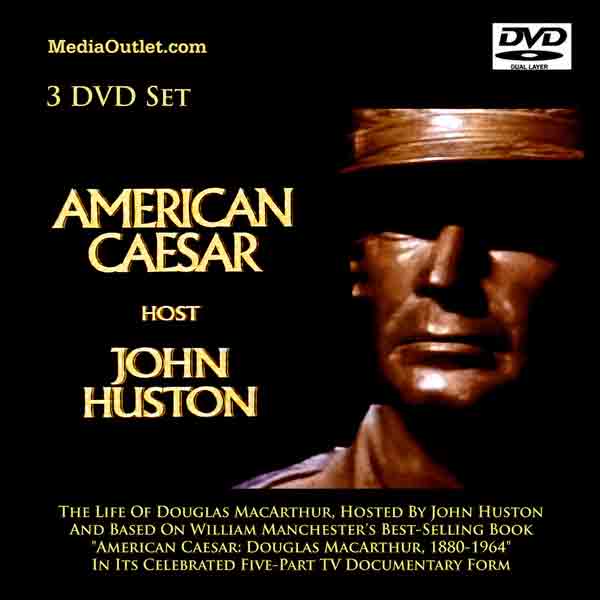
April 11, 1951: Korea: The History Of
Korea: The Aftermath Of World War II: The Cold War: The Korean
Conflict: The Korean War: President Truman's Relief Of General
Douglas MacArthur: -- U.S. President Harry S. Truman relieves
General of the Army Douglas MacArthur of his commands after
MacArthur made public statements which contradicted the
administration's policies. MacArthur was a popular hero of World
War II who was then the commander of United Nations forces
fighting in the Korean War, and his relief remains a controversial
topic in the field of civil-military relations. MacArthur led the
Allied forces in the Southwest Pacific during World War II, and
after the war was in charge of the occupation of Japan. When North
Korea invaded South Korea in June 1950, starting the Korean War,
he was designated commander of the United Nations forces defending
South Korea. He conceived and executed the amphibious assault at
Inchon on 15 September 1950, for which he was hailed as a military
genius. However, when he followed up his victory with a full-scale
invasion of North Korea on Truman's orders, China intervened in
the war and inflicted a series of defeats, compelling him to
withdraw from North Korea. By April 1951, the military situation
had stabilized, but MacArthur's public statements became
increasingly contradictory of and irritating to Truman, and he
relieved MacArthur of his commands. The Senate Armed Services
Committee and the Senate Foreign Relations Committee held a joint
inquiry into the military situation and the circumstances
surrounding MacArthur's relief, and concluded that "the
removal of General MacArthur was within the constitutional powers
of the President but the circumstances were a shock to national
pride"; General Marshall told him that if the decision were
up to him, "I'd fire the son of a bitch.". An apolitical
military was an American tradition, but one that was difficult to
uphold in an era when American forces were employed overseas in
large numbers. The principle of civilian control of the military
was also ingrained, but the rising complexity of military
technology led to the creation of a professional military. This
made civilian control increasingly problematic when coupled with
the constitutional division of powers between the President as
commander-in-chief, and the Congress with its power to raise
armies, maintain a navy, and wage wars. In relieving MacArthur for
failing to "respect the authority of the President" by
privately communicating with Congress, Truman upheld the
President's role as pre-eminent. Though the decision was extremely
unpopular at the time, it has become the most respected decision
of the Truman administration. On Sale @ 15% Off Discount Till
Midnight PT!
https://store.earthstation1.com/american-caesar-douglas-macarthur-tv-series-3-dvds-john-husto3.html
Today's
EarthStation1.com 15% Off Commemorative Memorial Title: Black
Civil Rights Films: African-American History DVD, MP4, USB Stick
Today, April 11, 2026
April 11, 1955: The American Civil Rights
Movement: Civil Rights Organizations: African American Civil
Rights Organizations: The National Association For The Advancement
Of Colored People (NAACP): -- Roy Wilkins, following the death of
NAACP Executive Secretary Walter White, is unanimously elected
NAACP Executive Secretary (title later changed to Executive
Director), and serves in this capacity until July 1977. Roy
Wilkins, prominent activist in the Civil Rights Movement in the
United States from the 1930s to the 1970s, known in later life as
the "Senior Statesman" of the Civil Rights Movement
(August 30, 1901 - September 8, 1981) was born Roy Ottoway Wilkins
in St. Louis, Missouri. The grandson of a Mississippi slave, he
was a prominent activist in the Civil Rights Movement in the
United States from the 1930s to the 1970s. Wilkins' most notable
role was in his leadership as Executive Director of the National
Association for the Advancement of Colored People (NAACP). Wilkins
participated in the March on Washington (August 1963), which he
helped organize, the Selma to Montgomery marches (1965), and the
March Against Fear (1966). Roy Wilkins died of uremia (kidney
failure) in New York City, New York, eight days after his 80th
birthday in New York City, U.S. In 1982, his autobiography
Standing Fast: The Autobiography of Roy Wilkins was published
posthumously. On Sale @ 15% Off Discount Till Midnight PT!
https://store.earthstation1.com/black-civil-rights-films-africanamerican-history-dvd.html
Today's
EarthStation1.com 15% Off Commemorative Memorial Title: The
Unforgettable Nat King Cole + Destination Freedom Docs DVD MP4 USB
Today, April 11, 2026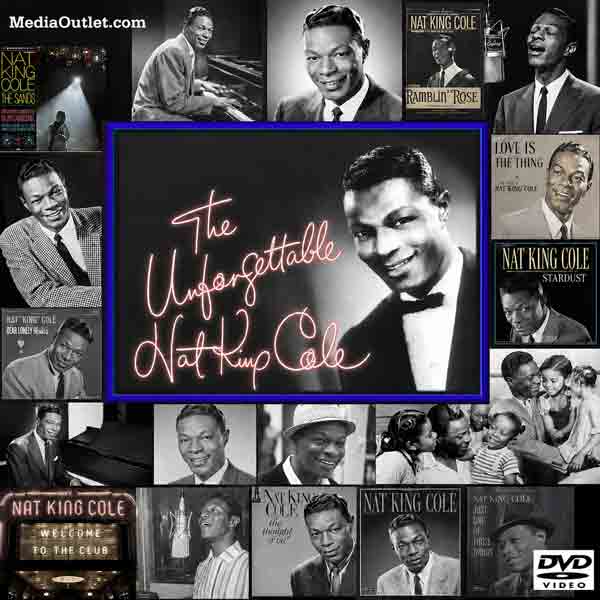
April 11, 1956: The American Civil Rights
Movement: Anti-Black Racism In The United States: The 1956 Nat
King Cole Kidnapping And Murder Plot: -- Nat King Cole is attacked
by six white men as he sang from the stage of Birmingham,
Alabama's Municipal Auditorium on a Tuesday night performing with
The Ted Heath Band. Since Birmingham required segregated audiences
for such shows, Cole was scheduled to perform at two shows at that
venue that night: the first for white patrons only, the second for
black patrons. He was attacked during the first performance while
singing the end of the second of two numbers in the concert,
"Little Girl". Having circulated photographs of Cole
with white female fans bearing incendiary boldface captions
reading "Cole and His White Women" and "Cole and
Your Daughter", four white men rushed him belonging to the
North Alabama Citizens Council assaulted Cole, three of them
having run down the aisles of the auditorium, mounting the high
stage and plunging over the footlights, knocking Cole and the
microphone to the floor, in an attempt to kidnap and murder Cole.
Several policemen rushed from the wings of the auditorium,
grabbing the attackers. Cole and his manager Bob Schwartz claimed
at the time that Cole was not injured in the attack, but in the
ensuing melee Cole was toppled from his piano bench and received a
slight injury to his back. Cole returned to the stage shortly
afterwards, and apologized for not being able to continue the
program. Cole went on to give his second performance for black
patrons shortly after the attack as scheduled. Local law
enforcement quickly ended the invasion of the stage, and took
three white men to Birmingham police headquarters: Willie Richard
Vinson and Kenneth Adams, both of Anniston , Alabama, and Jesse
Mabry, who gave a Birmingham address . Adams and Mabry were
charged with inciting a riot, and were held without bond . Vinson
was accused of striking one policeman with a bottle and breaking
the glasses of another officer. He was detained for further
questioning. A fourth member of the group was later arrested. All
were tried and convicted.In total six men, including 23-year-old
Willie Richard Vinson, were formally charged with assault with
intent to murder him, but later the charge against four of them
was changed to conspiracy to commit a misdemeanor. The original
plan to attack Cole included 150 men from Birmingham and nearby
towns. After being attacked in Birmingham, Cole said, "I
can't understand it ... I have not taken part in any protests. Nor
have I joined an organization fighting segregation. Why should
they attack me?" Cole said he wanted to forget the incident
and continued to play for segregated audiences in the American
South. He said he could not change the situation in a day. He
contributed money to the Montgomery Bus Boycott and had sued
northern hotels that had hired him but refused to serve him.
Thurgood Marshall, the chief legal counsel of the NAACP, called
him an Uncle Tom and said he should perform with a banjo. Roy
Wilkins, executive secretary of the NAACP, wrote him a telegram
that said: "You have not been a crusader or engaged in an
effort to change the customs or laws of the South. That
responsibility, newspapers quote you as saying, you leave to the
other guys. That attack upon you clearly indicates that organized
bigotry makes no distinction between those who do not actively
challenge racial discrimination and those who do. This is a fight
which none of us can escape. We invite you to join us in a crusade
against racism." The Chicago Defender said Cole's
performances for all-white audiences were an insult to his race.
The New York Amsterdam News said that "thousands of Harlem
blacks who have worshiped at the shrine of singer Nat King Cole
turned their backs on him this week as the noted crooner turned
his back on the NAACP and said that he will continue to play to
Jim Crow audiences". To play "Uncle Nat's" discs,
wrote a commentator in The American Negro, "would be
supporting his 'traitor' ideas and narrow way of thinking".
Deeply hurt by the criticism in the black press, Cole was
chastened. Emphasizing his opposition to racial segregation "in
any form", he agreed to join other entertainers in boycotting
segregated venues. He paid 500 USD to become a lifetime member of
the Detroit branch of the NAACP. Until his death in 1965, Cole was
an active and visible participant in the civil rights movement,
playing an important role in planning the March on Washington in
1963. On Sale @ 15% Off Discount Till Midnight PT!
https://store.earthstation1.com/the-unforgettable-nat-king-cole-dvd-documentary.html
Today's
EarthStation1.com 15% Off Commemorative Memorial Title: Judgement
In Jerusalem: The Trial Of Adolf Eichmann DVD, MP4, USB
Today, April 11, 2026
April 11, 1961: The Aftermath Of World
War II: The European Civil War: World War II: The Second European
War (The European Theater Of World War II): The Holocaust (Shoah):
The Eichmann Trial: -- SS Obersturmbannfuehrer (Lieutenant
Colonel) Adolf Eichmann, one of the major organizers of the
Holocaust, goes on trial in Jerusalem, Israel. Otto Adolf Eichmann
was tasked by SS-Obergruppenfuehrer (general/lieutenant general)
Reinhard Heydrich with facilitating and managing the logistics
involved in the mass deportation of Jews to ghettos and
extermination camps in Nazi-occupied Eastern Europe during World
War II. Eichmann said towards the end of the war that he would
"leap laughing into the grave because the feeling that he had
five million people on his conscience would be for him a source of
extraordinary satisfaction.". After Germany's defeat in 1945,
Eichmann fled to Austria. He lived there until 1950, when he moved
to Argentina using false papers. Information collected by the
Mossad, Israel's intelligence agency, confirmed his location in
1960. A team of Mossad and Shin Bet agents captured Eichmann and
brought him to Israel to stand trial on 15 criminal charges,
including war crimes, crimes against humanity, and crimes against
the Jewish people. During the trial, he did not deny the truth of
the Holocaust or his role in organising it, but claimed that he
was simply following orders in a totalitarian Fuehrerprinzip
system. He was found guilty on many of the charges and was
sentenced to death by hanging; he was executed on June 1, 1962.
The trial was widely followed in the media and was later the
subject of several books, including Hannah Arendt's work Eichmann
in Jerusalem, in which Arendt coined the phrase "the banality
of evil" to describe Eichmann. On Sale @ 15% Off Discount
Till Midnight PT!
https://store.earthstation1.com/judgement-in-jerusalem-the-trial-of-adolf-eichmann-dvd.html
Today's
EarthStation1.com 15% Off Commemorative Memorial Title: LBJ 1991
TV Documentary Series Lyndon Johnson DVD Download USB Drive
Today, April 11, 2026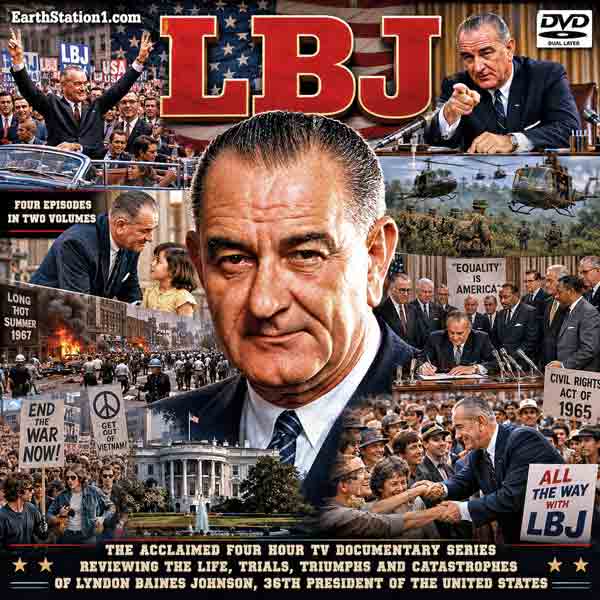
April 11, 1968: The American Civil Rights
Movement: Anti-Racism: Anti-Racism In The United States:
Anti-Discrimination Law In The United States: The Civil Rights Act
Of 1968: -- President Lyndon B. Johnson signs the Civil Rights Act
Of 1968, prohibiting discrimination in the sale, rental, and
financing of housing. The Civil Rights Act Of 1968, (Pub.L.
90-284, 82 Stat. 73, enacted April 11, 1968), also known as the
Fair Housing Act, is a landmark part of legislation in the United
States that provided for equal housing opportunities regardless of
race, religion, or national origin and made it a federal crime to
"by force or by threat of force, injure, intimidate, or
interfere with anyone _ by reason of their race, color, religion,
or national origin." The Act was signed into law during the
King assassination riots by President Lyndon B. Johnson, who had
previously signed the Civil Rights Act and Voting Rights Act into
law. On Sale @ 15% Off Discount Till Midnight PT!
https://store.earthstation1.com/lbj-1991-tv-documentary-series-lyndon-johnson-dvd-download-usb-d1991.html
Today's
EarthStation1.com 15% Off Commemorative Memorial Title: Outer
Space Films 5: Apollo Moon Exploration Films DVD, Download, USB
Today, April 11, 2026
April 11, 1970: Rocket Launches: The
History Of Spaceflight: The Aftermath Of World War II: The Cold
War: The Space Age: Space Programs Of The United States: Human
Spaceflight Programs: Missions To The Moon: Project Apollo: Apollo
13 (AS-13): -- Apollo 13 is launched from Cape Kennedy at 14:13
Eastern Time (13:13 Central Time at Mission Control Center in
Houston, Texas, which took over the flight the moment it launched)
from the Kennedy Space Center Launch Complex 39 (LC-39) at Cape
Kennedy, Florida. Apollo 13 was the seventh manned mission in the
Apollo space program and the third intended to land on the Moon,
but the lunar landing was aborted after an oxygen tank exploded
two days later, crippling the Service Module (SM) upon which the
Command Module (CM) had depended. Despite great hardship caused by
limited power, loss of cabin heat, shortage of potable water, and
the critical need to make makeshift repairs to the carbon dioxide
removal system, the crew returned safely to Earth on April 17,
1970, six days after launch. The flight passed the far side of the
Moon at an altitude of 137 nautical miles above the lunar surface,
248,655 nautical miles from Earth, a spaceflight record marking
the farthest humans have ever traveled from Earth. The mission was
commanded by James A. Lovell with John L. "Jack" Swigert
as Command Module Pilot and Fred W. Haise as Lunar Module Pilot.
Swigert was a late replacement for the original CM pilot Ken
Mattingly, who was grounded by the flight surgeon after exposure
to German measles. The story of the Apollo 13 mission has been
dramatized multiple times, most notably in the 1995 film Apollo
13. Fifty six hours into the flight an oxygen tank exploded in the
service module. Astronaut John L. Swigert saw a warning light that
accompanied the bang and said, "OK, Houston, we've had a
problem here." Swigert, James A. Lovell and Fred W. Haise
then transferred into the lunar module, using it as a "lifeboat"
and began a perilous return trip to Earth. On Sale @ 15% Off
Discount Till Midnight PT!
https://store.earthstation1.com/outer-space-films-5-apollo-moon-exploration-dv5.html
Today's
EarthStation1.com 15% Off Commemorative Memorial Title: The
Machine That Changed The World The Computer + Bonus 3 MP4s Or DVDs
Today, April 11, 2026
April 11, 1976: Product Launches: The
History Of The Computer: The History Of The Computer Industry: The
History Of The Personal Computer (The History Of The PC): The
Apple Computer 1 (The Apple I, The Apple Computer, Apple-1): --
The Apple Computer 1, now known as the Apple I, originally
released as the Apple Computer and known later as the Apple I, or
Apple-1, is released. The Apple I is a desktop computer released
by the Apple Computer Company (now Apple Inc.) in 1976. It was
designed by Steve Wozniak. The idea of selling the computer came
from Wozniak's friend and co-founder Steve Jobs. The Apple I was
Apple's first product, and to finance its creation, Jobs sold his
only motorized means of transportation, a VW Microbus, for a few
hundred USD (Wozniak later said that Jobs planned instead to use
his bicycle to get around), and Wozniak sold his HP-65 calculator
for 500 USD. Wozniak demonstrated the first prototype in July 1976
at the Homebrew Computer Club in Palo Alto, California. Production
was discontinued on September 30, 1977, after the June 10, 1977
introduction of its successor, the Apple II, which Byte magazine
referred to as part of the "1977 Trinity" of personal
computing (along with the PET 2001 from Commodore Business
Machines and the TRS-80 Model I from Tandy Corporation). On Sale @
15% Off Discount Till Midnight PT!
https://store.earthstation1.com/the-machine-that-changed-the-world-the-computer-dvd-mp4-downloa4.html
Today's
EarthStation1.com 15% Off Commemorative Memorial Title: The Sword
Of Islam: The Islamic Revolution DVD MP4 USB Flash Drive
Today, April 11, 2026
April 11, 1987: The Cold War (1956,
1967-1991): The Arab-Israeli Conflict: The Israeli-Palestinian
Conflict: The Peres-Hussein London Agreement (The London
Agreement): -- Israeli Foreign Affairs Minister Shimon Peres and
King Hussein of Jordan secretly sign The London Agreement, which
outlined the framework for an international peace conference
hosted by the United Nations, at the residence of Lord Mishcon in
London, England. The purpose of the agreement would be "the
peaceful solution of the Arab-Israeli conflict based on
resolutions 242 and 338 and a peaceful solution of the Palestinian
problem in all its aspects." The agreement also stipulated
that the conference would not impose a solution on the parties,
and that the Palestinians would be represented by the Jordanian
delegation. Its requirements that all parties accept UNSC
Resolutions 242 and 338 as well as renounce violence and terrorism
effectively excluded PLO participation. The signatories agreed
that their plan would be presented to US Secretary Of State George
Shultz for its promotion as an American initiative. On Sale @ 15%
Off Discount Till Midnight PT!
https://store.earthstation1.com/the-sword-of-islam-the-islamic-revolution-dvd-mp4-usb-flash-driv4.html
Today's
EarthStation1.com 15% Off Commemorative Memorial Title: The Man
Who Made The Supergun: Gerald Bull's Supergun Affair MP4 DVD
Today, April 11, 2026
April 11, 1990: Artillery: Large-Calibre
Artillery: Superguns: The Aftermath Of World War II: The Cold War:
The Arab-Israeli Conflict: The Supergun Affair: -- Customs
officers in Middlesbrough, England, say they have seized what they
believe to be the barrel of a massive gun on a ship bound for
Iraq, a gun determined to be of Gerald Bull's supergun design;
less than four months later, Iraq's President Saddam Hussein
invaded Kuwait, a conflict wherein this gun would certainly have
been used to target Israel in the same way Scud missiles were used
against them. The Supergun Affair was a 1990 political scandal in
the United Kingdom that involved two businesses, Sheffield
Forgemasters and Walter Somers, Gerald Bull, members of parliament
Hal Miller and Nicholas Ridley, the UK's Secret Intelligence
Service, a failed prosecution and components of a "supergun"
(as newspaper headlines had it) that the businesses were alleged
to have been exporting to Iraq that they and others had contacted
the government about in 1988. The collapse of the court case
preceded the Arms-to-Iraq case, that involved a different company
Matrix Churchill, by four months. Canadian engineer Gerald Bull
became interested in the possibility of using 'superguns' in place
of rockets to insert payloads into orbit. He lobbied for the start
of Project HARP to investigate this concept in the 1960s, using
paired ex-US Navy 16"/50 calibre Mark 7 gun barrels welded
end-to-end. Three of these 16"/100 (406 mm) guns were
emplaced, one in Quebec, Canada, another in Barbados, and the
third near Yuma, Arizona. HARP was later cancelled, and Bull
turned to military designs, eventually developing the GC-45
howitzer. Some years later, Bull interested Saddam Hussein in
funding Project Babylon. The objective of this project is not
certain, but one possibility is that it was intended to develop a
gun capable of firing an object into orbit, whence it could then
drop onto any place on the Earth. Gerald Bull was assassinated in
March 1990, terminating development and the parts were confiscated
by British customs after the Gulf War. On Sale @ 15% Off Discount
Till Midnight PT!
https://store.earthstation1.com/the-man-who-made-the-supergun-gerald-bulls-supergun-affair-mp4-dvd.html
Today's
EarthStation1.com 15% Off Commemorative Memorial Title: Desert
Triumph: The Gulf War TV Documentary Series DVD & MP4 Download
Today, April 11, 2026
April 11, 1991: The Aftermath Of World
War II: The Cold War: The Gulf War (The Persian Gulf War, Gulf War
I): The Aftermath Of The Gulf War: The Gulf War Armistice: -- The
Gulf War formally ends with an armistice signed between the
Coalition and Iraqi Army. On the prior March 3, Iraq accepted the
terms of a ceasefire from the U.N. Security Council. The Gulf War
began as Operation Desert Storm in the early morning of January
17, 1991. The Gulf War (August 2, 1990 - February 28, 1991),
codenamed Operation Desert Shield (August 2, 1990 - January 17,
1991) for operations leading to the buildup of troops and defense
of Saudi Arabia, and Operation Desert Storm (January 17, 1991 -
February 28, 1991) in its combat phase, was a war waged by
coalition forces from 35 nations led by the United States against
Iraq in response to Iraq' invasion and annexation of Kuwait. The
war is also known under other names, such as the Persian Gulf War,
First Gulf War, Gulf War I, Kuwait War, First Iraq War or Iraq
War, before the term "Iraq War" became identified
instead with the 2003 Iraq War. On Sale @ 15% Off Discount Till
Midnight PT!
https://store.earthstation1.com/desert-triumph-the-gulf-war-tv-documentary-series-dvd-amp-mp4-downloa4.html
Today's
EarthStation1.com #OnThisDay Commemorative Memorial Title:
Remember When: The Image Makers US Advertising w/ Dick Cavett MP4
DVD
Today, April 11, 2026 April 11: National Marketing Operations
Appreciation Day: -- Celebrate the individuals and technology that
help marketing teams thrive. Started by the workflow automation
leader Zapier, the day recognizes the work that goes into great
marketing campaigns. It also creates awareness about the
importance of automation in marketing operations planning,
execution, and reporting - allowing marketers to focus on what
matters most. National Marketing Operations Appreciation Day
honors the marketing managers, analysts, and specialists who power
a business's marketing strategies. Marketing ops professionals
create and maintain the tools and systems that marketing teams use
to develop and execute successful campaigns. Marketing operations
as a concept has been around since marketers started trying to
better understand their audiences in the early part of the 20th
century. But as the tools and data available to marketing teams
have evolved, especially in the past two decades, marketing ops
has quickly expanded into a defined field. Since 2011, Zapier has
been supporting marketing operations systems to help teams run
efficiently and focus on the human side of marketing. The no-code
interface allows anyone - regardless of technical ability - to
automate marketing ops workflows, from managing user data to
triggering email campaigns.
https://store.earthstation1.com/remember-when-image-makers-dvd-us-advertising-dick-cavett.html
Today's
EarthStation1.com #OnThisDay Commemorative Memorial Title:
Barnum's Big Top: P. T. Barnum's Circuses + 2 Bonuses MP4 Download
DVD
Today, April 11, 2026April 11, 1906: #DOTD: #RIP: James
Anthony Bailey, American circus ringmaster, co-founded Ringling
Bros. and Barnum & Bailey Circus (b. July 4, 1847) #dies of
erysipelas in 1906 at age 58. He is buried in Woodlawn Cemetery,
in The Bronx, New York City. His widow subsequently sold the
circus to the Ringling brothers in 1907, who eventually merged the
rival operations in 1919. In his book about the circus, Earl
Chapin May wrote, "Probably...no circus owner and manager
left more sincere mourners than the thin little magnate known to
millions as James A. Bailey." Taped beneath a photo of James
Bailey in the scrapbook of employee Harrison Gunning is a small
scrap of paper that reads, "P.T. Barnum was the great
showman, but Mr. Bailey was the supreme of all circus managers,
past and present." James A. Bailey was inducted into the
International Circus Hall of Fame in 1960 and into the Circus Ring
of Fame in Sarasota, Florida in 1990. James Anthony Bailey was
born James Anthony McGinnis to Edward and Hannora McGinnis in
Detroit, Michigan. Edward McGinnis died in October, 1849 of
cholera and in 1855, James was orphaned when his mother died.
James then went to live with his older sister, Catherine Gordon.
Life with Catherine was difficult as she tended to be overbearing
and harsh. Sometime between 1859 and 1860, James ran away from
Catherine's home and found a job and a place to stay on a farm
about 10 miles outside the city of Pontiac, Michigan. Finding life
on the farm unrewarding, 13-year old James wandered into Pontiac
where he found work at the Hodges House Hotel. After working at
the hotel for a time, he was discovered by Colonel Frederic
Harrison Bailey, a nephew of circus pioneer Hachaliah Bailey, and
an advance man for John Robinson and Bill Lake's traveling circus.
F.H. Bailey gave McGinnis a job as his assistant, and the two
traveled together for many years. McGinnis eventually adopted F.H.
Bailey's surname to become James A. Bailey. In his diary, James'
brother-in-law Joe McCaddon writes that Bailey recounted stories
of how he left the circus world at age 16 and went to work as
clerk to a sutler during the Civil War (a sutler or victualer is a
civilian merchant who sells provisions to an army in the field, in
camp, or in quarters). In 1866, with the war over, he went back to
work for Bill Lake, who now owned his own circus with his wife
Agnes Thatcher Lake. During this time, James met Ruth Louisa
McCaddon of Zanesville, Ohio. James and Ruth became friends, fell
in love, and were married in December 1868. The very next year in
Granby, Missouri, Bill Lake was shot and killed. With her husband
dead, Agnes Lake became the first woman in the United States to
own a circus (Agnes Lake would later marry famous gunfighter Wild
Bill Hickok, who worked for a short time with Buffalo Bill Cody,
whose Wild West Show James A. Bailey would one day manage). Bailey
later associated with James E. Cooper, and by the time he was 22,
he was manager of the Cooper and Bailey circus. He then met with
P.T. Barnum, and together they established Barnum and Bailey's
Circus (for which Bailey was instrumental in obtaining Jumbo the
Elephant) in 1880, with their combined show opening the following
spring in Madison Square Garden. Barnum was the face of the
circus, but James Bailey was the hard worker who insisted on
staying behind the scenes. Barnum once wrote to him that James
managed the show "ten times better than I could."
Equestrienne Josie Demott Robinson wrote in her autobiography
that, "Mr. Barnum was the advertiser, who loved the
limelight, who rode around in the ring, and announced who he was.
But Mr. Bailey was the businessman, content to be invisible...and
interested only in the success of the show." Bailey was
considered by many to be a genius at logistics. His organizational
skills for transporting people, animals, and equipment was copied
by the military of more than one country. He hired Pinkerton
Detectives to travel with the show and protect circusgoers from
grifters and thieves. He established "Orphan Day", one
day a year when orphans could attend the circus for free. He was
often known to carry children who couldn't walk into the circus
tent and find them a seat away from the crush of the crowd.
Following Barnum's death in 1891, Bailey managed not only The
Barnum and Bailey Greatest Show on Earth, but in 1894, took on the
management of Buffalo Bill's Wild West Show.
https://store.earthstation1.com/barnum39s-big-top-dvd-p-t-barnum-and-his-circuses-dvd-mp4-394.html
Today's
EarthStation1.com #OnThisDay Commemorative Memorial Title: Outer
Space Mission MP3 MegaSet DVD, Audio Download, USB Flash Drive
Today, April 11, 2026April 11, 2007: #DOTD: #RIP: Kurt
Vonnegut, American novelist, short story writer, and playwright
whose published work includes fourteen novels, three short-story
collections, five plays, and five nonfiction works over fifty
years, along with further works having been published since his
death, best known for his satirical and darkly humorous and
countercultural novels (b. November 11, 1922) #dies in Manhattan,
New York in the evening aged 84 as a rsult of brain injuries
incurred several weeks prior in a fall at his brownstone home. His
remains were cremated, and his ashes were scattered wtih
permission of his widow Jill over Mount Greylock, the highest
point in Massachusetts, part of the Taconic Mountains, a
geologically distinct range from the nearby Berkshires and Green
Mountains. A book composed of his unpublished pieces, Armageddon
in Retrospect, was compiled and posthumously published by his son
Mark in 2008. In 2017, Seven Stories Press published Complete
Stories, a collection of Vonnegut's short fiction. Born and raised
in Indianapolis, Indiana, Vonnegut attended Cornell University,
but withdrew in January 1943 and enlisted in the U.S. Army. As
part of his training, he studied mechanical engineering at the
Carnegie Institute of Technology and the University of Tennessee.
He was then deployed to Europe to fight in World War II and was
captured by the Germans during the Battle of the Bulge. He was
interned in Dresden, where he survived the Allied bombing of the
city in a meat locker of the slaughterhouse where he was
imprisoned. After the war, he married Jane Marie Cox. He and his
wife both attended the University of Chicago while he worked as a
night reporter for the City News Bureau. Vonnegut published his
first novel, Player Piano, in 1952. It received favorable reviews
yet sold poorly. In the nearly 20 years that followed, several
well-regarded novels were published, including The Sirens of Titan
(1959) and Cat's Cradle (1963), both of which were nominated for
the Hugo Award for best science fiction novel of the year. His
short-story collection, Welcome to the Monkey House, was published
in 1968. Vonnegut's breakthrough was his commercially and
critically successful sixth novel, Slaughterhouse-Five (1969). Its
anti-war sentiment resonated with its readers amid the Vietnam
War, and its reviews were generally positive. It rose to the top
of The New York Times Best Seller list and made Vonnegut famous.
Later in his career, Vonnegut published autobiographical essays
and short-story collections such as Fates Worse Than Death (1991)
and A Man Without a Country (2005). When asked about the impact
Vonnegut had on his work, author Josip Novakovich stated that he
has "much to learn from Vonnegut-how to compress things and
yet not compromise them, how to digress into history, quote from
various historical accounts, and not stifle the narrative. The
ease with which he writes is sheerly masterly, Mozartian."
Los Angeles Times columnist Gregory Rodriguez said that the author
will "rightly be remembered as a darkly humorous social
critic and the premier novelist of the counterculture", and
Dinitia Smith of The New York Times dubbed Vonnegut the
"counterculture's novelist".
https://store.earthstation1.com/outer-space-mission-mp3-dvd-megaset-4-dis34.html
Today's
EarthStation1.com #OnThisDay Commemorative Memorial Title:
Election Held Hostage 1980 Hostage Deal + Intelligence Abuse MP4 &
DVD
Today, April 11, 2026April 11, 1938: #BOTD: #HBD: Michael
Deaver, American politician, Deputy White House Chief Of Staff (d.
August 18, 2007) is #born in Bakersfield, California. Mike Deaver
was a member of President Ronald Reagan's White House staff
serving as White House Deputy Chief Of Staff under James Baker III
and Donald Regan from January 1981 until May 1985. While serving
on Reagan's staff, Deaver worked closely with Chief Of Staff James
Baker and Counselor to the President Ed Meese. They were known as
"The Troika" by some observers of the White House due to
their influence over policy while they served on the White House
staff. As Deputy Chief Of Staff at the White House, Deaver worked
primarily on media management forming how the public perceived
Reagan, sometimes by engineering press events so that the White
House set the networks' agenda for covering the president. On
March 30, 1981, Deaver stood feet away from John Hinckley as he
fired at Reagan, wounding him. Deaver later supported Nancy Reagan
in the hospital as she arrived. Deaver resigned from the White
House staff in May 1985. On March 18, 1987, Deaver was convicted
of perjury for congressional testimony he had submitted. He was
convicted on three of five counts of perjury stemming from
statements to a congressional subcommittee and federal grand jury
investigating his lobbying activities with administration
officials. Deaver blamed alcoholism for lapses in memory and
judgment. He was sentenced to three years in prison, but the
sentence was reduced to three years of probation and a fine of
100K USD. Deaver was also ordered to perform 1,500 hours of public
service. In the final days of Reagan's presidency the question of
a pardon arose, but Reagan noted in his diaries that Deaver
indicated he would not accept a pardon. Michael Deaver died of
pancreatic cancer at age 69 at his home in Bethesda, Maryland. In
a statement, Nancy Reagan, said: "[Deaver] was the closest of
friends to both Ronnie and me in many ways, and he was like a son
to Ronnie... We met great challenges together... I will miss Mike
terribly." His burial details are not publicly disclosed.
#MichaelDeaver #Soldiers #Politicians #Lobbyists
#WhiteHouseDeputyChiefsOfStaff #PresidencyOfRonaldReagan
#Republicans #MediaManagement #POTUS #POTUSHistory
#AmericanHistory #USHistory #HistoryOfTheUS #MP4 #VideoDownload
#DVD
https://store.earthstation1.com/the-election-held-hostage-1990-election-for-hostages-deal-dvd-mp19904.html
Today's
EarthStation1.com #OnThisDay Commemorative Memorial Title: The
Fatal Attraction Of Adolf Hitler TV Series DVD, Download, USB
Today, April 11, 2026April 11, 2005: #DOTD: #RIP: Alfons Heck,
Hitler Youth Officer, fanatical adherent of Nazism during the
Third Reich, recipient of the Iron Cross from Adolf Hitler
personally, who as a hostile attendee at the Nuremberg Trials
learned the truth about the Nazis and then resolved to turn his
life around to help prevent what happened to him from from
happening to children in other totalitarian societies (b. November
3, 1928) #dies of heart failure at Scripps Mercy Hospital in San
Diego at the age of 76. In the 1970s, Heck began to write candidly
of his youthful military experiences in news articles and two
books. Thereafter, he entered into a partnership with Jewish
Holocaust survivor Helen Waterford, each presenting their
differing wartime circumstances before more than 200 audiences,
most notably in schools and colleges. Heck was born in the
Rhineland. He was raised by his grandparents at their farm in the
crossroads wine country community of Wittlich, Germany. When he
entered school at the age of 6, he and his classmates were first
exposed to effective Nazi indoctrination by their
virulently-nationalistic teacher. Four years later, Heck and his
classmates joined the five million in the Hitler Youth. Heck was a
good student and found learning easy. He was appointed leader of
about ten other boys. By then, his indoctrination and his devotion
to the proud future of Hitler's Third Reich were nearly complete.
He understood that the first rule of service to a greater Germany
was to follow orders without question, and he was willing to
report "suspicious actions" or comments, even by friends
or family, to his leader. At 14, all Deutsches Jungvolk were
required to join the senior Hitler Youth branch, the Hitlerjugend.
In part to avoid becoming an infantry officer, Heck applied to the
elite Flying Hitler Youth (Flieger Hitlerjugend), although he was
apprehensive about its year-long glider plane training. But within
weeks he became obsessed with flying and landing gliders. His life
course had changed. He would not study to be a priest, as his
grandmother had hoped. Heck devoted himself to the task of
becoming a Luftwaffe fighter pilot. He had been taught to believe
that living under Bolshevik-Jewish slavery was too horrible to
contemplate, leaving German victory as the only alternative.
Capture seemed to him worse than death. He thought that only a
glorious death over the battlefield stood in the way of his
sharing in Germany's inevitable triumph. His final transformation
to fanaticism had begun. He described this extended period of
glider training from late 1942 until early 1944 as the happiest of
his life. At 16, Heck became the youngest scholar to receive a
diploma from Aeronaut's Certificate in Sailplane Flying. Heck
recalls the audience response to Hitler: "We erupted into a
frenzy of nationalistic pride that bordered on hysteria. For
minutes on end, we shouted at the top of our lungs, with tears
streaming down our faces: Sieg Heil, Sieg Heil, Sieg Heil! From
that moment on, I belonged to Adolf Hitler body and soul."
However, the Allied invasion of France in 1944 caused his group of
180 Flying Hitler Youth, of which Heck had become the officer in
charge, to be returned to the Wittlich area to organise the
excavation of large anti-tank barriers on the nearby defensive
Westwall. Battlefield losses raised Heck's Hitler Youth rank to
Bannfuhrer, nominally in charge of 3,000 Hitler Youth workers in
the town and its 50 surrounding villages. One of his antiaircraft
crews shot down a damaged B-17 bomber trying to return to its
base. Later, he gave orders in a combat engagement against
advancing Americans in which participants on both sides were
killed. He was considered by friends and superiors to be ambitious
and ruthless. At one point, he gave orders to have an elderly
Luxembourg priest shot if he dared return to the school that Heck
had commandeered for his workers. The priest did not return. In
another incident, he drew his pistol to shoot a Hitler Youth
deserter but was prevented from doing so by a Wehrmacht sergeant.
Heck admitted at the time, as well as afterwards, that he had
become intoxicated by the power he wielded. As the approaching
Americans consolidated their gains, the 16-year-old Bannfuhrer was
ordered back to his Luftwaffe training base. Once there, with the
suspension of training, flight candidates were being ordered to
the front lines to face the American infantry. However, a
Luftwaffe officer, likely for the purpose of preserving Heck's
life, ordered Heck to organise the retrieval of needed radar
equipment near Wittlich and then to take a four-day leave in his
home town. This enabled Heck to don civilian clothes before
surrendering to the advancing Americans. Unaware of his Hitler
Youth rank, the American soldiers used Heck as a translator until
French military authorities began occupying the area. The French
arrested Heck, who served six months of hard labor before finally
being released. Heck was unable to believe that the atrocities
perpetrated by the Nazi regime had actually taken place. Despite
the difficulty of traveling within occupied Germany, he made his
way to Nuremberg to witness what he could of the trials of former
Nazi officers and officials. He later emigrated to Canada, working
in several British Columbia sawmills. He then moved to the US,
where, living in San Diego, he became a Greyhound long-distance
bus driver. During the 1950s and 1960s, Alfons Heck remained
silent about his wartime activities and his involvement in the
Hitler Youth, but he read hundreds of books about the Third Reich,
tracing the lives of surviving Nazi leaders and maintaining an
interest in West German politics. He came to feel that his
generation of young Germans had been callously betrayed by Nazi
strategists. Of the nine and a half million German war dead, two
million were teenagers, both civilians and Hitler Youth. In 1971,
at the age of 43, he became disabled by heart disease. Without a
productive future and increasingly frustrated by his
contemporaries' failure to speak out, Heck began attending writing
classes so that he might record what it was like to have been a
pawn of Nazi militarism. In 1985, he published A Child of Hitler:
Germany in the Days When God Wore a Swastika (Arizona: Renaissance
House, 1985), an account of his life under Nazism. He continued
with The Burden of Hitler's Legacy (Frederick, Colorado:
Renaissance House, 1988). Heck began touring with Waterford in
1980 to talk about their experiences before, during, and after the
war. The aligned speakers became friends as they visited more than
150 universities over nine years, urging youths to avoid
Hitler-type brainwashing. Colorado publisher Eleanor Ayer, who
published Waterford's autobiography "Commitment to the Dead"
in 1987, wrote Waterford and Heck's intertwined stories in her
1995 book Parallel Journeys. In 1989, Heck appeared in the BBC
Documentary The Fatal Attraction of Adolf Hitler. In 1991, he
featured in HBO's documentary Heil Hitler Confessions Of A Hitler
Youth. The film won an ACE for best documentary. In 1992, Heck was
awarded an Emmy for "outstanding historical programming."
In 1991, an HBO documentary based on his books titled Heil Hitler!
Confessions of a Hitler Youth was released. With Heck's narration
and using archived footage, it attempted to explain how millions
of the German youth of the Third Reich followed Nazi propaganda
and became some of the most extreme Hitler followers. Heck also
provided testimony on parallels between the attraction of Nazism
and Islamism and was featured in the documentary Obsession:
Radical Islam's War Against the West.
https://store.earthstation1.com/the-fatal-attraction-of-adolf-hitler-dvd-2-part-tv-documentary-serie2.html
Today's
EarthStation1.com #OnThisDay Commemorative Memorial Title: The
Steve Allen TV Shows MegaSet DVD, Video Download, USB Flash Drive
Today, April 11, 2026April 11, 2013: #DOTD: #RIP: Jonathan
Winters, American comedian, actor, author, screenwriter and artist
(b. November 11, 1925) #dies of natural causes during a Montecito,
California evening, at the age of 87. He was survived by his two
children, Jonathan ("Jay") Winters IV and Lucinda
Winters, and five grandchildren. He was cremated and his ashes
were given to his family. He was born Jonathan Harshman Winters
III in Bellbrook, Ohio. Beginning in 1960, Winters recorded many
classic comedy albums for the Verve Records label. He also had
records released every decade for over 50 years, receiving 11
Grammy nominations for Best Comedy Album during his career and
winning a Grammy Award for Best Album for Children for his
contribution to an adaptation of The Little Prince in 1975 and the
Grammy Award for Best Spoken Comedy Album for Crank(y) Calls in
1996. With a career spanning more than six decades, Winters also
appeared in hundreds of television show episodes/series and films
combined, including eccentric characters on The Steve Allen Show,
The Garry Moore Show, The Wacky World of Jonathan Winters
(1972-74), Mork and Mindy, Hee Haw, and It's a Mad, Mad, Mad, Mad
World. He also voiced Grandpa Smurf on The Smurfs TV series from
1986 to the show's conclusion in 1989. Over twenty years later,
Winters was introduced to a new generation through voicing Papa
Smurf in The Smurfs (2011) and The Smurfs 2 (2013). Winters died
nine days after recording his dialogue for The Smurfs 2; the film
was dedicated in his memory. In 1991, Winters won the Primetime
Emmy Award for Outstanding Supporting Actor in a Comedy Series for
playing Gunny Davis in the short-lived sitcom Davis Rules. 1999
saw Winters became the 2nd recipient of the prestigious Mark Twain
Prize for American Humor. In 2002, he was nominated for the
Primetime Emmy Award for Outstanding Guest Actor in a Comedy
Series for his performance as Q.T. Marlens on Life with Bonnie.
Winters was presented with a Pioneer TV Land Award by Robin
Williams in 2008. Winters also spent time painting and presenting
his artwork, including silkscreens and sketches, in many gallery
shows. He authored several books. His book of short stories,
titled Winters' Tales (1988), made the bestseller lists.
https://store.earthstation1.com/complete-steve-allen-tv-shows-4-dual-layer-dvd-megase4.html
Today's
EarthStation1.com #OnThisDay Commemorative Memorial Title: The
Goon Show British Radio Comedy Series MP3 DVD, Download, USB Drive
Today, April 11, 2026April 11, 2001: #DOTD: #RIP: Harry
Secombe, Welsh-English comedian, singer and actor who played
Neddie Seagoon, a central character in the BBC radio comedy series
The Goon Show (b. September 8, 1921) #dies at the age of 79 from
prostate cancer in hospital in Guildford, Surrey, England. He was
cremated, and his ashes are interred at the parish church of
Shamley Green, and a later memorial service to celebrate his life
was held at Westminster Abbey on October 26, 2001. As well as
family members and friends, the service was also attended by
Charles, Prince of Wales and representatives of Prince Philip,
Duke of Edinburgh, Anne, Princess Royal, Princess Margaret,
Countess of Snowdon and Prince Edward, Duke of Kent. On his
tombstone is the inscription: "To know him was to love him."
At Peter Sellers's funeral in 1980, Secombe sang a hymn; Spike
Milligan joked: "I hope you die before me because I don't
want you singing at my funeral." After Milligan's death in
2002, a recording of Secombe singing Guide me, O Thou great
Redeemer was played at Milligan's memorial service. The Secombe
Theatre in Sutton, Greater London, was named after him. He is also
fondly remembered at the London Welsh Centre, where he opened the
bar on St Patrick's Day, March 17, 1971. Harry Secombe was born
Harry Donald Secombe in St Thomas, Swansea, Wales. Sir Harry
Donald Secombe, CBE also played many other characters on the show
as well. An accomplished tenor, he also appeared in musicals and
films - notably as Mr Bumble in Oliver! (1968) - and, in his later
years, was a presenter of television shows incorporating hymns and
other devotional songs.
https://store.earthstation1.com/the-goon-show-otr-mp3-dvd-spike-milligan-peter-sellers-secomb3.html
Today's
EarthStation1.com #OnThisDay Commemorative Memorial Title: The
Stations Of Bach DVD, MP4 Video Download, USB Flash Drive
Today, April 11, 2026April 11, 1727: Premieres: Theatre
Premieres: Musical Premieres: -- Johann Sebastian Bach's St
Matthew Passion BWV 244b premieres at the St. Thomas Church,
Leipzig. The St Matthew Passion is Passion (music depticting the
passion of Jesus on Good Friday, the day of his crucifixion) in
the form of a sacred oratorio for solo voices, double choir and
double orchestra, with libretto by Picander. It sets chapters 26
and 27 of the Gospel of Matthew (in the Luther Bible) to music,
with interspersed chorales and arias. It is widely regarded as one
of the masterpieces of classical sacred music. St. Thomas Church
(German: Thomaskirche) is a Lutheran church in Leipzig, Germany.
It is associated with a number of well-known composers such as
Richard Wagner and Felix Mendelssohn Bartholdy, but mostly with
Johann Sebastian Bach who worked here as a Kapellmeister (music
director) from 1723 until his death in 1750. Today, the church
also holds his remains. Martin Luther preached here in 1539.
https://store.earthstation1.com/the-stations-of-bach-dvd-johann-sebastion-bach-documentary.html
Today's
EarthStation1.com #OnThisDay Commemorative Memorial Title:
Hollywood Without Make-Up: Film Star Home Movies DVD MP4 Download
USB
Today, April 11, 2026April 11, 1983: #DOTD: #RIP: Dolores del
Rio, Mexican actress and beauty, the first major female Latin
American crossover star in Hollywood (b. August 3, 1904) #dies
from liver failure at the age of 78 in Newport Beach, California.
It is said that the day she died, an invitation to attend the
Oscars was sent to her. She was cremated and her ashes were moved
from the United States to Mexico where they were buried at the
Panteon de Dolores in Mexico City, Mexico, specifically on The
Rotunda of Illustrious Persons. Born Maria de los Dolores Asunsolo
y Lopez Negrete in Victoria de Durango, Mexico, Dolores del Rio is
also considered one of the most important female figures in the
Golden Age of Mexican cinema, with a career spanning more than 50
years, and a notable career in American cinema during the 1920s
and 1930s. After being discovered in Mexico, she began her film
career in Hollywood in 1925. She had roles on a string of
successful films, including Resurrection (1927), Ramona (1928) and
Evangeline (1929). Del Rio came to be considered a sort of
feminine version of Rudolph Valentino, a "female Latin
Lover", in her years during the American "silent"
era. With the advent of sound, she acted in a range of film
genres, from contemporary crime melodramas to musical comedies and
romantic dramas. Among her most successful films of that decade
include Bird of Paradise (1932), Flying Down to Rio (1933) and
Madame Du Barry (1934). In the early 1940s, when her Hollywood
career began to decline, Del Rio returned to Mexico and joined the
Mexican film industry, which at that time was at its peak. When
Del Rio returned to her native country, she became one of the more
important stars of the Golden Age of Mexican cinema. A series of
Mexican films starring Del Rio, are considered classic
masterpieces and helped boost Mexican cinema worldwide. Of them
stands out the critically acclaimed Maria Candelaria (1943). Del
Rio remained active mainly in Mexican films throughout the 1950s.
In 1960 she returned to Hollywood. During the next years she
appeared in Mexican and American films. From the late 1950s until
the early 1970s she also successfully ventured into theater in
Mexico and appeared in some American TV series. Del Rio is now
considered a mythical figure of American and Mexican cinema, and a
quintessential representation of the female face of Mexico in the
world.
https://store.earthstation1.com/hollywood-without-makeup-dvd-film-star-home-movies.html
Today's
EarthStation1.com #OnThisDay Commemorative Memorial Title: Allied
Codebreakers Of WWI & WWII DVD MP4 Video Download USB Drive
Today, April 11, 2026April 11, 2016: #DOTD: #RIP: Ronnie
Hulick, one of three hundred United States Naval Women's Reserve
(W.A.V.E.S.) in Dayton, Ohio who worked during World War II on the
machines used to decipher the enemy's secret codes (b. January 4,
1923) #dies at Port St. Lucie Nursing and Restorative Care Center
at the age of 93. A Mass of Christian Burial was held at 11:00 am
on Monday, April 18, 2016 at St. Marks Catholic Church, 1924
Zephyr Avenue, Fort Pierce, FL. An inurnment ceremony was later
held at Arlington National Cemetery. Ronnie Hulick was born
Veronica Hulick in Wilmington, Delaware. She joined the WAVES
after graduating from P.S. DuPont High School. Historians say that
her efforts and those of her colleagues helped shorten the war by
at least two years, and led to the sinking of 750 enemy
submarines. After the war, she attended George Washington
University and later graduated from Temple University in
Philadelphia where she completed the dental hygienist program in
1948. Mrs. Hulick moved to Washington DC area where she raised her
children and worked for area dentists until she retired and moved
to Fort Pierce, Florida in 1987. She was active in local singing
groups, including the Nostalgia Follies. Her last performance was
on St. Patrick's Day at the Lynmoore assisted living facility. She
was a member of St. Mark's the Evangelist Church.
https://store.earthstation1.com/allied-codebreakers-of-wwi-amp-wwii-dvd-mp4-video-download-usb-driv4.html